Encyclopedia entry
Penis
Abstract
Bifid conditions and complete duplication (diphallus) may occur. Diphallia has a report frequency of 1/5.5 million births (US Public Health Service) (Cernach) Congenital absence of the penis has a frequency of 1/30,000,000 (documentation unavailable). An os penis has been reported. The first reported case of doubled penis was found on a cadaver, in Bologna, in 1609 by Wecker. It was reported as follows: Observatio. Pene gemino visus quidam. Vidimvs Bononia in publicis dissectionibus cadauer viri qui duplicem habuit penem. Cl. v.
Bifid conditions and complete duplication (diphallus) may occur. Diphallia has a report frequency of 1/5.5 million births (US Public Health Service) (Cernach)
Congenital absence of the penis has a frequency of 1/30,000,000 (documentation unavailable).
An os penis has been reported.
The first reported case of doubled penis was found on a cadaver, in Bologna, in 1609 by Wecker. It was reported as follows: Observatio. Pene gemino visus quidam. Vidimvs Bononia in publicis dissectionibus cadauer viri qui duplicem habuit penem. Cl. v. Ioannes Iacobus Weckerus in Suis mthi communicatis Obseruationibus. The first American case was provided by Van Buren and Keyes in 1874. Bruni (1926) reviewed 15 cases and added one of his own for a total of 16 cases, which he discussed in detail. Additional cases by McLennan, by Kimura, by Seth and Peacock, and by others increased the total to 29 cases that were found in the medical literature by 1932.
Double Penis
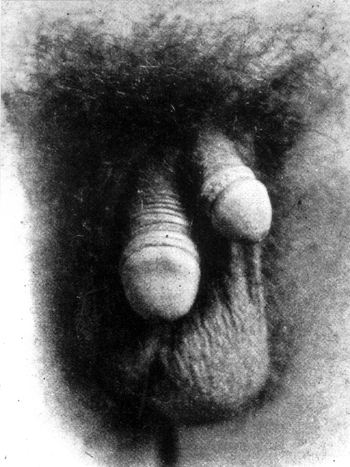
Anatomy Atlases. Image hosted by the site it comes from. Open the original page.
Double Penis in Child
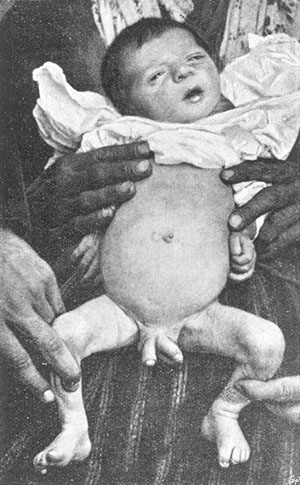
Anatomy Atlases. Image hosted by the site it comes from. Open the original page.
Double Penis and Imperforate Anus
Ectopic Scrotum and Diphallia
First Reference to Doubled Penis
Diphallia and Pseudodiphallia
Riferimenti dell’opera originale
Elenco riportato come compare nella fonte, senza normalizzazione dei formati bibliografici.
- Adair, E.L. and E.L. Lewis. (1960) Ectopic scrotum and diphallia. journal 84:115-117.
- Agarwal, S. and S.K. Sogani (1984) Diphallis. J. Ped. Surg. 19:213.
- Aleem, A.A. (1972) Diphallia: Report of a case. J. Urol. 108:357-358.
- Amir, S.S., Mughaireh, A.M., Uri, F.I., Bustami, F.M.F. and A.M. Shamayleh. (1984) Agenesis of the penis: Report of two cases and review of the literature. Jordan Med. J. 18:221-230.
- Anom. (18 65) Ein erwachsener Man mit doppelten, volkommen entwidkelten äusseren Geschlectstheilen. Wien. Med. Wochenschrift. 15(75): 1361-1364.
- Antony, J. and M.K. Chanrasekara. (1973) Penile agenesis. Internat. Surgery 58:650-652.
- Attie, J. (1961) Congenital absence of the penis: A report of a case with congenital concealed penile agenesis and congenital absence of the left kidney and ureter. J. Urol. 86:343-345.
- Bartkowiak, Z. (1955) Case of congenital abnormality: Double penis and double scrotum. Urologia Polska 8:173-176.
- Bartolin, T. (165 7) Duplex Penis. Historiarum Anatomicarum. Rariorum.
- Bauza, J.A. (1932) Marlforación genital (Bifallia parcial) con extrofia y malformaciones múltiples de las manos y pies. Archivos de Pediatria del Uruguay 3:353-355.
- Bruni, C. (1926) Arch. Ital. di Urol. 3:143-147.
- Bruni, C. (1926) Una rarissima anomalia degli organi genito-urinari: pene doppio. Archivio Italiano di Urologia. 3:143-147.
- Bruni, C. (1927) Seltene Anomalie der Urogenitalorgane: doppelter Penis. Zeitschr. f. Urol. 21:193-195.
- Campbell, M. (1954) Urology. W.B. Saunders Co. Philadelphia. vol. 1, pp. 397-398.
- Cernach, M.C.S.P., Hayashi, H., and D. Soares. (1989) Diphallia associated with malformation of hindgut derivatives. Urol. 33(3):209-210.
- Cochrane, W.J. and R.L.de C.H. Saunders. (1942) A rare anomaly of the penis associated with imperforate anus. J. Urol. 47:810-817.
- Cohen, S.J. (1968) Diphallis with duplication of the colon and bladder. Proc. R. Soc. Med. 61:305-306.
- Culp, O.S. (1970) Facts and fancies regarding anomalies of the male genitale. J. Arkansas Med. Soc, 66:429.
- Daut, W.W. and R.V. Daut. (1949) Accessory scrotum, posteriorly located: Review of literature and report of a case. J. Iowa Med. Soc. 39:194.
- DiBattista, C., Laudizi, L. and G. Tamborino. (1975) Focomelia ed agenesis pene in neonato. Minerva Pediatr. 27:675-679.
- Donald, C. (1930) A case of human diphallus. J. Anat. 64:523-526.
- Drury, R.B. and H.H. Schwarzell. (1935) Congenital absence of penis. Arch. Surg. 30:236-242.
- Farah, R. and G. Reno. (1972) Congenital absence of the penis. J. Urol. 107:154-155.
- Ferulano, O. and C. Alfano. (1957) An unusual case of diphallism associated with polyorchidism; contribution to the study of embryogenic dymorphism. Reforma Med. 71:1145-1161.
- Foshall, I. and P.P. Rickham. (1956) Transposition of the penis and scrotum. Brit. J. Urol. 28:250-252.
- Gillies, H. and R.J. Harrison. (1948) Congenital absence of the penis. Brit. J. Plast. Surg. 1:8-28.
- Goligorskii, S.D. and L.G. Bardier. (1957) A case of plastic repair of bladder sphincter in congenital bifurcation fo penis with incontinence. Urologiia, Moskva 21:70-71.
- Harris, R.P. (1898) Congenital absence of the penis, the urethra making its exit into or below the rectum, and emptying the bladder by or exterior to, the anus. Philadelphia Med. Journal 1:71-77.
- Heller, J. (1908) Zwei seltene Missbildungen des Penis; a) Diphallus partialis; b) Sogenannte Verdoppelung der Harnröhre. Zeitschr. f. Urol. 2:612-617.
- Hollowell, Jr., J., Witherington, R., Ballagas, A.J. and J.N. Burt. Embryologic considerations of diphallus and associated anomalies. J. Urol. 117:728-732.
- Johnson, C.F., Carlton, Jr., C.E. and N.B. Powell. (1974) Duplication of the Penis. Urol. 4:723-725.
- Johnston, W.G., Jr., Yeatman. G.W. and J.W. Weigel. (1977) Congenital absence of the penis. J. Urol. 117:508-511.
- Kessler, W. and A.P. McLaughlin. (1973) Agenesis of the penis. Embryology and management. Urology 1:226-229.
- Kherumian, B.R. (1948) Note sur la longueur de pénis des habitants de l'europe centrale. Bull. et Mém. de la Soc. d'Anthrop. de Paris. 9:138-142.
- Kimura, H. (1930) The Japan Medical World 10:63-66.
- Kirsch, E. Total diphallia: case report of urinary tract abnormalities. Ztschr. Urol. 48:711-720.
- Kogan, B.A., Hricak, H. and E.A. Tanagho. (1987) Magnetic resonance imaging in genital anomalies. J. Urol. 138:1028-1030.
- Kukstinat, G.J. and R.J. Hasterlik. (1939) Congenital absence of penis. Arch. Pathol. 27:984-993.
- Küttner, H. (1896) über angeborene Verdoppelung des Penis. Beitr. Klin. Chir. 15:364-374.
- Lange, M. (1898) über komplette Verdoppelung des Penis, kombiniert mit rudimentärer Verdoppelung der Harnblase und Atresia ani. Beitr. Pathol. Anat. Allg. Pathol. 24:223-230.
- Lipshutz, A. (1924) A note on a case of bifid penis. J. Anat. 58:254-255.
- Lisa, L., Hanak, J., Cerny, M., Faflova, H., Kafka, H. J. Braza. (1973) Agenesis of the penis. J. Pediatr. Surg. 8:327-328.
- MacKenzie, J.I. (1878) Congenitally impervious prepuce. Brit. Med. J. 1:335.
- Mac Lachlan, D. (1894) Case of double penis. Brit. Med. 1 (2) 1894:964.
- MacLenam, A. (1924) Double penis. Glasgow Med. J. 101:287-288.
- Marten, A. (1863) Die angeborene Verwachsung des Penis und Scrotum. Arch. Pathol. Anat. Physiol. Klin. Med. 28:555-556.
- Melicow, M.M. and A.C. Uson. (1964) A periodic tale of sexual anomalies. J. Urol. 91:402-429.
- Meyer, R. (1941) Dislocation of the phallus, penis and clitoris, following pelvic malformations in the human fetus. Anat. Rec. 79:231-241.
- McCrea, L.E. (1942) Congenital absence of the penis. J. Urol. 47:818
- McLennan, A. (1924) ??????????????. Glasgow Medical Journal 101:287-288.
- Mingazzini, E. (1955) A case of double penis. Urol. Internat. 1:188-190.
- McIlvoy, D.B. and H.S. Harris. (1955) Transposition of penis and scrotum: Case report. J. Urol. 73:540.
- Nesbit, R.M. and W. Bromme. (1933) Double penis and double bladder: with report of a case. Am. J. Roentgenol. 30:497-502.
- Perez, C.A. (1957) Complete diphallia. Arch. Españ. Urol. 13:10-20.
- Pires de Lima, J.A. (1915) Note on a case of bifid penis, with penial hypospadia. J. Anat. Physiol. 44:85-89.
- Pohlandt, F., Kühn, H., Teller, W. and H. Thomä. (1974) Penisagenesie. Weibliche Geschlechtszuweisung unter psychtherapeutischer Betreuung der Eltern. Dtsch. Med. Wochenschrift 99:2166-2172.
- Rao, T.V. and- V. Chandrasekharan. (1980) Diphallus with duplication of cloacal derivatives: Report of rare case. J. Urol. 124:555-557.
- Rauber, -. (1890) Angeborener Mangel des männlichen Gliedes. Arch. Pathol. Anat. Physiol. Klin. Med. 121:604.
- Richart, R. and K. Benirschke. (1960) Penile agenesis. Report of a case, review of the world literature, and discussion of pertinent embryology. Arch. Pathol. 70:252-260.
- Romanovsky, R. (1905) Dystopia testis transversa. Anat. Anz. 26:635-639.
- Seth, R.E. and A.H. Peacock. (1932) Double penis. Urol. Cutaneous Rev. 36:590-592.
- Smith, D.R. (1967) Repair of hypospadias in the preschool children: A report of 150 cases. J. Urol. 97:723-730.
- Soderdahl, D.W., Brosman, S.A. and W.E. Goodwin. (1972) Penile agenesis. J. Urol. 108:496-499.
- Solomon, A.A., Rosenthal, I. and M.H. Linker. (1950) Double penis associated with supernumerary kidney. J. Urol. 64:705-709.
- Tessler, A.N. and P. Mahmood. (1973) Blind-ending duplications of the ureter. Urology, 1:46-50.
- Van Buren, and Keyes. (1974) Genito-Urinary Diseases with Syphilis. pp. 4-5.
- Van Buren, W.H. and E.L. Keyes. (1874) A Practical Treatise on the Surgical Diseases of the Genito-Urinary Organs, including Syphilis. pp. 4- 5. Appleton, New York.
- Vera-Roman, J.M. (1973) Robinow dwarfing syndrome accompanied by penile agenesis and hemivertebrae. Am. J. Diseases Child. 126:206-208.
- Villanova, X. and A. Raventos. (1954) Pseudodiphallia, a rare anomaly. J. Urol. 71:338-346.
- Volpe, M. (1903) Dell'asta doppia. Policlin., Roma (sez Chir.) 10:46-52.
- Wecker, I. (1609) Observationum Medicarum. Rararum, Admirabiium et Monstruosarum Column. Lib IV. De Partibus Genitalibus, p. 577. Pene Gemino Visus Qudam. Francofurti, 1609.
- Wecker, I. (1609) Observationum Medicarum. Rararum, Admirabhum et Monstruosarum Columen. Lib IV. De Partibus Genitalibus, p.5 77. Pene Gemino Visus Quidam. In Schenck von Grafenberg, Johannes. Paratereseon, sive observationum medicarum, novarum, admirabilium, & monstrosarum, volumen, tomis septem de toto homine institutum. In quo, quae medici....,Francofurti, E typographeo Nicolai Hoffh-ianni, impensa Jonae Rhodii, 1609.
- Wojewski, A. and W. Kossowski. (1964) Total diphalli: A case of plastic repair. J. Urol. 91:84-86.
Anatomical classification
- Systems:
- Genitourinary system
Content provenance
Adaptation
Adaptation of «Penis — Illustrated Encyclopedia of Human Anatomic Variation: Opus I: Muscular System» by Ronald A. Bergman, Adel K. Afifi, Ryosuke Miyauchi. Source: https://www.anatomyatlases.org/AnatomicVariants/OrganSystem/Text/Penis.shtml Original work distributed under the CC BY-NC-SA 4.0 licence (https://creativecommons.org/licenses/by-nc-sa/4.0/deed.it). Adaptation by Redazione AIVA. Changes from the original: Testo originale inglese riprodotto integralmente e riorganizzato nel formato scheda del portale (sintesi, testo, riferimenti), senza modificarne le affermazioni. La traduzione italiana non è ancora stata eseguita, e la pagina lo dichiara. Le figure non sono state copiate: sono collegate alla pagina d’origine. This publication is not approved or endorsed by the authors of the original work.
Licence
This content is distributed under the licence CC BY-NC-SA 4.0. Licences and attribution
