Voce enciclopedica
Basilar Artery
Abstract
The basilar artery may exist as two longitudinal trunks that may be united by anastomoses. Occasionally, the basilar splits into two vessels that reunite. When the two vessels fuse, the resulting single vessel may have a median sagittal partition. In some subjects, the basilar passes through a foramen in the dorsum sellae. An aberrant branch may arise that pierces the dorsum sellae and joins the internal carotid.
The basilar artery may exist as two longitudinal trunks that may be united by anastomoses. Occasionally, the basilar splits into two vessels that reunite. When the two vessels fuse, the resulting single vessel may have a median sagittal partition. In some subjects, the basilar passes through a foramen in the dorsum sellae. An aberrant branch may arise that pierces the dorsum sellae and joins the internal carotid. In one case of a rudimentary vertebral artery that stopped short of the skull, the basilar arose as a branch of the internal carotid in the neck and entered the cranial cavity through the hypoglossal canal. The vertebral artery on the contralateral side ended as a posterior inferior cerebellar artery.
In a study of the causes of variations in form and position of the vertebral and basilar arteries, von Eichhorn suggested that atypical artery position and arterial loops were more common in subjects of advanced age. The present authors know that carotid artery loops may be caused by pathology and this may also be true in von Eichhorn's study as well. Additional study is required to settle this matter.
Image 417
Variation in Circle of Willis in Chinese
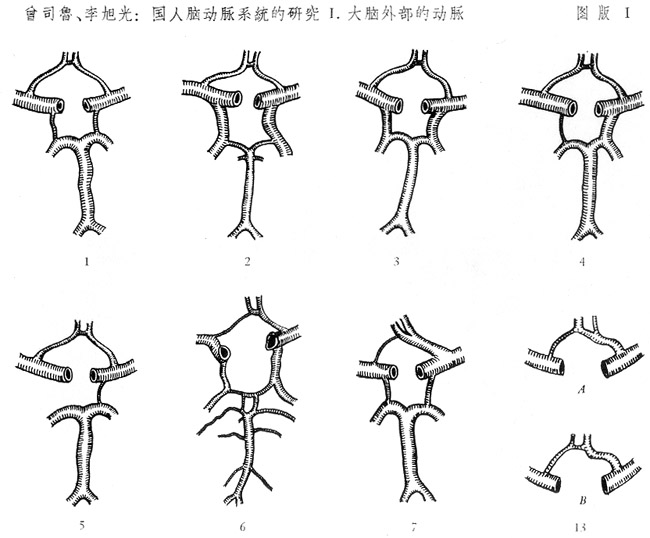
Anatomy Atlases. Immagine ospitata dal sito d’origine. Apri la pagina originale.
Absence of:
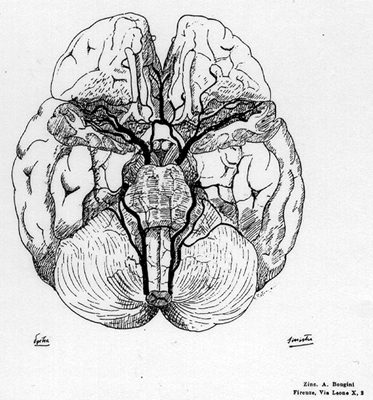
Anatomy Atlases. Immagine ospitata dal sito d’origine. Apri la pagina originale.
Riferimenti dell’opera originale
Elenco riportato come compare nella fonte, senza normalizzazione dei formati bibliografici.
- Anson, B.J., Ed. (1966) Morris' Human Anatomy, 12th ed., The Blakiston Division, McGraw-Hill Book Company, New York.
- Batujeff, N. (1889) Eine seltene Arterienanomalie (Ursprung der A. basilaris aus der A. carotis interna) Anat. Anz. 4:282-285.
- Belen'kaia, R.M. (1974) Structural variations in the arteries of the base of the brain. Vopr. Neirokhir. 5:23-29. In Russian.
- Bergman, R.A., Thompson, S.A., Afifi, A.K. and F.A. Saadeh. (1988) Compendium of Human Anatomic Variation: Catalog, Atlas and World Literature. Urban & Schwarzenberg. Baltimore and Munich.
- Berry, R. and J. Anderson. (1910) A case of nonunion of the vertebrales with consequent abnormal origin of the basilaris. Anat. Anz. 35:54-65.
- Bohutova, J., Markorva, J., and J. Neuwirth. (1990) Anomolies of the basilar and vertebral arteries that are of practical importance. Rofo. 153(4): 427-431. In German.
- Cieslicki, K., Gielecki, J. and T. Wilczak. (1997) Redundancy of the main cerebral arteries in morphological variations of the Willis circle. Neurol. Neurochir. Pol. 31(3):463-474. In Polish.
- DeCaro R. Serafini, M.T., Galli, S., Parenti, A., Guidolin, D., and P.F. Munari. (1995) Anatomy of segmental duplication in the human basilar artery. Possible site of aneurysm formation. Clin. Neuropathol. 14(6):303-309.
- von Eichhorn, M. (1990) Ursachen für die Entstehung von Variationen im Verlauf der Arteria vertebralis und der Arteria basilaris. Gegenbaurs morphol. Jahrb., Leipzig 136(1): 127-134.
- García Cañizares, D.F. (1895) Anomalias Arteriales. Revista de Ciencias Medicas 10:75-77.
- Gergiigeviski, I.V. (1906) A variation of the basilar artery. In Russian. Khirurgiia 20:475-486.
- Hillen, B. (1986) The variability of the circle of Willis: univariate and bivariate analysis. Acta Morphol. Neerl Scand. 24(2): 87-101.
- Kameyama, N. (1962) Clinicopathological significance of variationsn in the basilar arteries. Yokufuen Chosa Kenkyu Kiyo 35:13-26. In Japanese.
- Kopsch, F. (1908) Rauber's Lehrbuch und Atlas der Anatomie des Menschen. Georg Thieme, Leipzig.
- Megyesi, J.F., Findlay, J.M., and R. A. Sherlock. (1997) Carotid endarterectomy in the presence of a persistent hypoglonsal artery: case report. Neurosurgery 41(3):669-672.
- Okahara, M., Kiyosae, H., Mori, H.. Tanoue, S., Sainou, M. and H. Nagatomi. (2002) Anatomic variations of the cerebral arteries and their embryology and a pictoral review. Eur. Radio. 12(10):2548-2561.
- Poynter, C.W.M. (1916) Arterial anomalies pertaining to the aortic arches and branches arising from them. The University Studies of the University of Nebraska, Lincoln 16:229-345.
- Poynter, C.W.M. (1922) Congenital anomalies of the arteries and veins of the human body with bibliography. The University Studies of the University of Nebraska, Lincoln 22:1-106.
- Sander, W. (1878) Auffälliges Verhalten der Basilararterie. Arch. Pathol. Anat. Physiol. Klin. Med. 72:284-285.
- Schaefer, E.A., Symington, J. and T.H. Bryce. (1915) Quain's Anatomy, 11th ed., Longmans, Green and Co., London.
- Scheffner, D. (1962) Combination of a cartiod-basilar anastomosis with unusual variations. Fortschr. Geb Rontgenstr. Nuklearmed. 97:810-812. In German.
- Serres, -. (1830) Anatomie Transcendante. - Quatrième Mémoire. Loi de symétrie et de conjugaison du système sanguin. Annales des Sciences Naturelles 21:5-49.
- Smith, G.E. (1909) Note on an anomalous anastomosis between the internal carotid and the basilar artery. J. Anat. Physiol. 43:310-311.
- Tseng, S-L and H-K. Li. (1965) An observation of arterial system of Chinese brains. I. The external arteries of the brain.[Chieh p'ou Hsüeh Pao] Acta Anatomica Sinica 8:278-292.
- Uchino, A., Sawada, A., Takase, Y. and S. Kudo. (2003) Variations of the superior cerebellar artery. MR angiographic demonstration. Radiat. Med. 21(6):235-238.
- Waddington, M.M. (1974) Atlas of Cerebral Angiography with Anatomic Correlation. Little, Brown and Co., Boston.
Classificazione anatomica
- Sistemi:
- Sistema cardiovascolare
Provenienza del contenuto
Adattamento
Adattamento di «Basilar Artery — Illustrated Encyclopedia of Human Anatomic Variation: Opus I: Muscular System» di Ronald A. Bergman, Adel K. Afifi, Ryosuke Miyauchi. Fonte: https://www.anatomyatlases.org/AnatomicVariants/Cardiovascular/Text/Arteries/Basilar.shtml Opera originale distribuita con licenza CC BY-NC-SA 4.0 (https://creativecommons.org/licenses/by-nc-sa/4.0/deed.it). Adattamento a cura di Redazione AIVA. Modifiche rispetto all’originale: Testo originale inglese riprodotto integralmente e riorganizzato nel formato scheda del portale (sintesi, testo, riferimenti), senza modificarne le affermazioni. La traduzione italiana non è ancora stata eseguita, e la pagina lo dichiara. Le figure non sono state copiate: sono collegate alla pagina d’origine. Questa pubblicazione non è approvata né avallata dagli autori dell’opera originale.
Licenza
Questo contenuto è distribuito con licenza CC BY-NC-SA 4.0. Licenze e attribuzioni