Voce enciclopedica
Reni, ureteri, vescica e uretra
Abstract
Secondo Gutierrez il 40% delle condizioni patologiche dell'apparato urinario è dovuto a variazioni. I reni possono variare per numero, dimensioni, forma, posizione e rotazione — con quadri quali il rene a ferro di cavallo, il rene pelvico e l'agenesia — e altrettanto variabili sono l'apparato escretore, l'uretere, la vescica e l'uretra.
Secondo Gutierrez, il 40% delle condizioni patologiche dell'apparato urinario è dovuto a variazioni. Variazioni urologiche si riscontrano nel 10% delle variazioni vertebrali, nel 15% dei casi di meningocele o mielomeningocele, nel 25% dei casi di ano doppio, nel 42% delle duplicazioni del colon e nel 90% delle duplicazioni dei genitali (Cernak, 1989).
I reni talvolta si discostano dalla loro forma normale, risultando o più lunghi e stretti, oppure più corti e arrotondati.
La caratteristica lobulazione fetale può persistere nell'adulto (7%).
Occasionalmente un rene è molto piccolo, mentre l'altro risulta proporzionalmente ingrandito.
Sono documentati numerosi casi di assenza di un rene, più frequentemente il destro. L'assenza congenita di un rene ha una frequenza riportata dello 0,24% (6.500 autopsie); in un altro studio su 52.198 casi l'incidenza dell'agenesia è risultata di 1/1000, ossia lo 0,10%.
Il rene ectopico ha una frequenza riportata compresa fra 1:500 e 1:110; il rene ectopico toracico, 1:13.000 (rene solitario, 1:1.000; rene pelvico solitario, 1:22.000; un rene normale e uno pelvico, 1:3.000, ed ectopia renale crociata, 1:7.000.
Il rene unico è di norma ingrandito, ma non invariabilmente. Il rene sinistro è di solito più grande del destro.
Berengario da Carpi (1523) fu il primo a scrivere di reni fusi con configurazione a ferro di cavallo. Essi furono tuttavia descritti e illustrati per la prima volta da Botallo nel 1564. Quando è allungato, il rene può giacere, in parte, dietro l'esofago.
In media, nel maschio il rene destro misura 12,7 X 6,3 cm mentre il sinistro misura 13,2 X 6,4 cm. Nella femmina il destro misura 12,4 X 5,9 cm e il sinistro 12,8 X 6,1 cm. Questi dati provengono da studi radiologici. La presenza di un rene soprannumerario è rara. In un caso il rene destro era normale, mentre sul lato sinistro erano presenti due reni (uno superiore e uno inferiore) separati fra loro da una distanza di 3 cm. L'uretere del rene superiore si univa a quello del rene inferiore, cosicché nella vescica si aprivano soltanto due orifizi ureterali.
I due reni possono essere uniti per i loro poli superiori e inferiori o anche nella parte media degli organi. Essi incrociano anteriormente i grossi vasi e la colonna vertebrale. L'organo così congiunto ha di solito la forma di un ferro di cavallo, con la convessità rivolta in basso per la fusione delle estremità caudali dei due reni. Il rene a ferro di cavallo è stato riscontrato nello 0,21% di 6.500 autopsie in uno studio e nello 0,12% di 68.000 autopsie (1:850) in un altro. I dati cumulativi di 192 autori (202.777 autopsie e studi radiologici) indicano un totale di 378 reni a ferro di cavallo. L'incidenza è pertanto di circa 1:536, ossia lo 0,19%; l'84% dei casi nei maschi e circa il 17% nelle femmine. In uno studio su 2.424 casi sono stati trovati 15 reni a ferro di cavallo nei maschi e tre nelle femmine.
Talvolta due reni uniti si trovano nella regione lombare su un solo lato della colonna vertebrale, o più raramente nella cavità pelvica. Il rene pelvico è stato riscontrato nello 0,04% di 6.500 autopsie.
Sono stati descritti anche organi a forma di manubrio (dumbbell) o due reni discoidi uniti fra loro nel loro punto mediano.
I reni possono essere mobili, per la lassità della capsula areolare e adiposa. Queste condizioni si verificano molto più frequentemente a carico del rene destro. Il tessuto adiposo perirenale è continuo attraverso la linea mediana da un rene all'altro.
- Anomalie di numero
- Assenza di entrambi i reni
- Assenza di un rene (rene solitario)
- Rene doppio o multiplo (rene soprannumerario)
- Unilaterale o bilaterale
Variazioni di dimensione
- Rene ipoplasico.
- Vera ipoplasia renale.
- Aplasia renale.
- Rene ipertrofico.
- Lobulato.
- Compensato.
Variazioni di forma.
- Rene lungo.
- Rene corto.
- Rene largo.
- Rene lobulato.
- Rene cistico.
- Unilaterale.
- Bilaterale.
- Rene policistico.
- Unilaterale.
- Bilaterale.
- Rene fuso.
- Asimmetrico
- Rene a L.
- Rene sigmoide.
- Rene ad anello («en galette»).
- Rene «en masse».
Simmetrico (rene a ferro di cavallo).
- Con la concavità in alto.
- Con la concavità in basso.
- Con istmo fibroso.
- Con istmo costituito da vero parenchima renale.
- Con una, due, tre o quattro pelvi e ureteri.
Variazioni di posizione.
- Rene mobile o fluttuante.
- Rene ectopico.
- Semplice unilaterale.
- Semplice bilaterale.
- Bilaterale con fusione (rene a ferro di cavallo).
- Crociato con o senza fusione.
- Ciascuna di queste variazioni di posizione può essere lombare, iliaca, pelvica o mediana.
Variazioni di rotazione.
- Rotazione insufficiente.
- Unilaterale.
- Bilaterale.
- Rotazione eccessiva.
- Unilaterale.
- Bilaterale.
L'apparato escretore del rene (calici, pelvi e uretere):
- Calici
- Assenti
- Aberranti
- Numero, dimensione o posizione inconsueti
- Pelvi renale
- Assente
- Rudimentale
- Doppia (bifida) o multipla
- Unilaterale
- Bilaterale
- Idronefrosi (congenita)
- Pelvi intrarenale
- Unilaterale
- Bilaterale
- Pelvi extrarenale
- Unilaterale
- Bilaterale
- Diverticolo della pelvi renale
- Uretere
- Variazioni di numero
- Singolo (assenza di un uretere)
- Doppio da un lato
- Triplo
- Quadruplo
- Quintuplo
- Sestuplo
- Tutte le condizioni sopra elencate possono essere complete o incomplete. Possono ramificarsi.
- Variazioni di forma, dimensione e posizione
- Diverticolo dell'uretere
- Semplice
- Multiplo
- Uretere imperforato
- Stenosi dell'uretere
- Pio-uretere
- Idrouretere
- Megalo-uretere
- Dilatazione dell'uretere
- Totale
- Parziale
- Orifizio ureterale del tipo a «buca da golf»
- Uretere ectopico
- Malposizionato nella vescica
- In corrispondenza del fondo
- In un diverticolo
- In prossimità del collo vescicale, ecc.
- Con orifizio extravescicale che si apre in
- Un altro uretere
- Uretra
- Tratto genitale
- Intestino
- Uretere torto od occluso
- Ureteri incrociati
- Uretere con formazione di valvole
- Ureterocele
Modificato da Gutierrez, 1936.
I calici minori possono variare di numero da sei a 14; il numero minore indica che alcuni calici minori accolgono gli apici di più piramidi. Le variazioni dei calici minori e della pelvi sono più marcate.
I calici maggiori possono estendersi verso il basso per un certo tratto oltre l'ilo e terminare unendosi a formare l'uretere senza andare incontro a un'evidente dilatazione. In tali casi la pelvi è assente; se i calici si dilatano, possono essere presenti una o due pelvi.
È stato riportato che l'agenesia renale unilaterale associata ad anomalie genitali si verifica nel 12% degli uomini e nel 40% delle donne. Le anomalie della vescichetta seminale sono poco comuni, ma quando si verificano, nel 68% di tali casi si riscontra anche un'agenesia renale unilaterale.
L'anefrogenesi bilaterale ha un'incidenza dello 0,0017%.
È stata segnalata la presenza di tessuto renale eterotopico nel cuore e nella ghiandola surrenale.
La variazione principale dell'uretere è una divisione più o meno completa in due. Di regola i due ureteri si uniscono poco al di sopra della vescica, cosicché esiste un solo orifizio vescicale. Quando la divisione è completa, vi sono due aperture separate nella vescica. In uno studio su 26.480 autopsie sono stati riscontrati 136 ureteri doppi o bifidi (0,5%).
In rari casi si possono trovare tre o quattro ureteri. Sono documentati diversi casi in cui un uretere soprannumerario, proveniente dalla parte superiore del rene, si apriva direttamente nell'uretra. È stato riportato inoltre che gli ureteri possono aprirsi nella vagina, nella vescichetta seminale o nell'uretra prostatica.
L'uretere destro è stato trovato passare dietro la vena cava inferiore (uretere postcavale o retrocavale), fra tale vaso e l'aorta.
Sono state segnalate vesciche urinarie di forma variabile (per esempio la vescica a clessidra). La vescica può essere sdoppiata. L'agenesia ha un'incidenza riportata di 1:600.000 (0,00017%).
L'uretra può essere sdoppiata.
Rene a ferro di cavallo
Rene - a ferro di cavallo
Rene a ferro di cavallo
Rene a ferro di cavallo con tre ureteri
Rene pelvico
Terzo rene soprannumerario
Duplicazione bilaterale dell'uretere
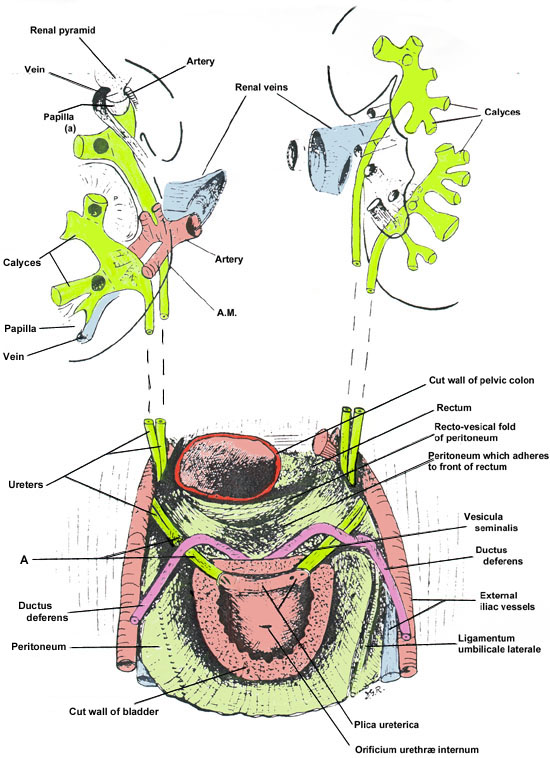
Anatomy Atlases. Immagine ospitata dal sito d’origine. Apri la pagina originale.
Tipi di uretra doppia
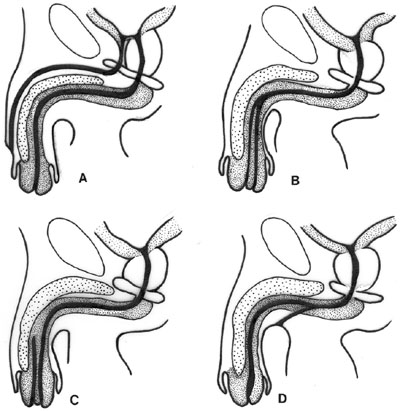
Anatomy Atlases. Immagine ospitata dal sito d’origine. Apri la pagina originale.
Uretere bifido incompleto unilaterale
Rene sigmoide
Ureteri bifidi bilaterali
Reni fusi
Reni fusi a ferro di cavallo
Reni a ferro di cavallo
Tipi di uretere triplice
Configurazioni della pelvi e dei calici
Rene a S congenito
Riferimenti dell’opera originale
Elenco riportato come compare nella fonte, senza normalizzazione dei formati bibliografici. Le voci non sono tradotte: un riferimento bibliografico si cita nella lingua in cui è pubblicato.
- Abeshouse, B.S. (1944) Surgery of the congenital anomalous kidney. Surg., Gynecol. Obstet. 78:288-303.
- Abeshouse, B.S. (1947) Crossed ectopia with fusion: Review of literature and a report of four cases. Am. J. Surg. 73:658-683.
- Abeshouse, B.S. and L.H. Tankin. (1952) Retrocaval ureter: Report of a case and a review of the literature. Am. J. Surg. 84:383-393.
- Adam, E.A. (1929) Report of a case of congenital single kidney with associated absence of uterus and vagina. New England J. Med. 200:1037.
- Adams, A.W. (1960) The movable kidney syndrome. A successful nephroprexy: Historical survey and current assessment. Brit. J. Surg. 48:319-323.
- Agran, M.A. and E.A. Kratzman. (1969) Inferior vena cava on the left side: Its relationship to the right ureter. J. Urol. 101:149-151.
- Albers, D.D., Geyer, J.R. and S.D. Barnes. (1968) Blind-ending branch of bifid ureter: Report of 3 cases. J. Urol. 99:160-164.
- Albers, D.D., Geyer, J.R. and S.D. Barnes. (1981) Clinical significance of the blind-ending branch of a bifid ureter: Report of three additional cases. J. Urol. 105:634-637.
- Albu, I., Vaida, A. and F. Grigorescu-Sido. (1973) Ein Fall von mehrfacher beidseitiger Nierenanomalie beim Menschen. Anat. Anz. 133:207-213.
- Alfert, J.J. and J.Y. Gillenwater. (1972) Ectopic vas deferens communicating with lower ureter: Embryologic considerations. J. Urol. 108:172-173.
- Almeda, F. de. (1933) Sur l'irrigation d'un rein en fer-à-cheval. Assoc Anatomistes, Comptes Rendus 28:16-18.
- Almquist, P.O. (1946) Unilateral double ureter with partly vaginal, partly normal outlet. Acta Chir. Scand. 93:495-502.
- Alt, R.E. (1934) Ectopic ureter in the female. J. Urol. 32:249-260.
- Amar, A.D. (1972) Treatment of reflux in bifid ureters by conversion to complete duplication. J. Urol. 108:77-78.
- Amolsch, A.L. (1937) Bilateral metanephric agenesis: With report of four cases. J. Urol. 38:360-370.
- Anders, J.M. (1910) Congenital single kidney, with report of a case; The practical significance of the condition with statistics. Am. J. of the Med. Sci. 139:313-327.
- Anderson, G.W., Rice, G.G. and B.A. Hariss, Jr. (1951) Pregnancy and labor complicated by pelvic ectopic kidney. J. Urol. 760-776.
- Ang, A.H. and W.F. Chan. (1972) Ectopic thoracic kidney. J. Urol. 108:211-212.
- Anile, A. (1899) A propos d'un rein en fer-à-Cheval. Arch. Ital. Biol. 32:468.
- Anson, B.J. and L.W. Riba. (1939) The anatomical and surgical features of ectopic kidney. Surg., Gynecol.Obstet. 68:37-44.
- Anson, B.J., Pick, J.W. and E.W. Cauldwell. (1942) The anatomy of commoner renal anomalies. Ectopic and horseshoe kidneys. J. Urol. 47:112-132.
- Attie, J. (1961) Congenital absence of the penis: A report of a case with congenital concealed penile agenesis and congenital absence of the left kidney and ureter. J. Urol. 86:343-345.
- Badenoch, A.W. (1946) Failure of ureogenital union. Surg. Gynecol. Obstet. 82:471-474.
- Baines, G.H. 91940) Supernumerary and ectopic ureters: Carcinoma of a double kidney, with ectopia of one ureter. Brit. J. Surg. 28:314-319.
- Ballowitz, E. (1895) über angeborenen, einseitigen, vollkommenen Nierenmangel. Arch. Pathol. Physiol. Klin. Med. 141:309-390.
- Banner, E.A. (1965) The ectopic kidney in obstetrics and gynecology. Surg.,, Gynec. Obstet. 121:32-36.
- Barry, J.M. and R.D. Fincher. (1984) Transplantation of a horseshoe kidney into 2 recipients. J. Urol. 131:1162-1163.
- Barth, -. (1850) Anomalie des reins. Bulletins et Mem. de la Société Anatomique de Paris XXV(4):115-116.
- Barth, -. (1853) Un rein unique avec deux uretèrs occupant le rein gauche. Bulletins et Mem. de la Société Anatomique de Paris XXVIII(11):338.
- Bastien, -. et -. Le Gendre. (1859) Absence complète de l'utérus de trompes, du vagin et du rein droit. Soc. Biol. Comptes Rendus des Séances et Mémoires 11:96-99.
- Baurys, W. (1951) Fused pelvic kidneys. J. Urol. 65:781-783.
- Becquerel, -. (1837) Rein unique. Bulletins et Memoirs de la Société Anatomique de Paris XII (5)(1837):132.
- Beer, R. and W.L.F. Ferber. (1937) Crossed renal ectopis (unilateral, fused, or elongate kidney): With report of fourteen cases clinically diagnosed and two cases encountered at autopsy during the past eighteen years. J. Urol. 38:541-561.
- Beer, E. and W.H. Mencher. (1938) Heminephroectomy in disease of the double kidney: Report of fourteen cases. Ann. Surg. 108:705-729.
- Begg, R.C. (1953) Sextuplicitas renum: A case of six functioning kidneys and ureters in an adult female. J. Urol. 70:686-693.
- Benjamin, J.A. and C.E. Tobin. (1951) Abnormalities of the kidneys, ureters, and perinephric fascia: Anatomic and Clinical study. J. Urol. 65:715-733.
- Benjamin, J.A. and D.M. Schullian. (1950) Observations on fused kidneys with horseshoe configuration: Contribution of Leonardo Botallo (1564). J. Hist. Med. 5:315-326.
- Blanchard, -. (1869) Rein unique en form de fer à cheval. Bulletins et Mem. de la Société Anatomique de Paris XLIV(6):302-303.
- Blin, L. (1852) Description d'un cas d'anomalie des members supérieurs et inférieurs. Réunion des deux reins en un seul. Bulletins et Mem. de la Société Anatomique de Paris XXVII(9,10):376-389.
- Blundon, K.L. (1962) The treatment of retrocaval ureter in the solitary kidney. J. Urol. 88:32-39.
- Boatman, D.L., Culp, Jr., D.A., Culp, D.A. and R.H. Flocks. Crossed renal ectopia. J. Urol. 108:30-31.
- Boetz, G. (1912) Considerations sur la pathologie et la chirurgie du rein en fer a cheval. J. Urol. (Paris) 1:193-204, 373-392, 502-516,633-654.
- Botallo, L. (1564) De catarrho commentarius...Addita est fine monstrorum renum figura, muper in Cadauere repertorum. Paris.
- Botallo, L. (1660) Opera omnia (with notes by Johannes Van Horne). Leyden.
- Boujinah, J. and S. Zmerli. (1973) L'uretère bifide à branche borgne. A propos d'un cas. J. Urol. Néphrol. 89:61-63.
- Boulgakow, B. and N. Fahmy. (1926) A case of unilateral duplication of the ureter. J. Anat. 60:342-344.
- Bouliane, R. and A. Slomic. (1978) Uretère double à branche borgne. Présentaion d'un cas et review de la littérature. J. Radiol. Electrol. 59:49-52.
- Boyd, R. (1841) Case of malposition of the kidneys, absence of the vagina, uterus, and Fallopian tubes; disease of left ovary. Medico-Chirurg. Trans. 24:187-189.
- Boyden, E.A. (1937) Congenital absence of the kidney. An interpretation based upon a 10 mm human embryo exhibiting unilateral renal agenesis. Anat. Rec. 52:325-349.
- Boyden, E.A. (1932) Description of a horseshoe kidney associated with left inferior vena cava and disc-shaped suprarenal glands, together with a note on the occurrence of horseshoe kidneys in human embryos. Anat. Rec. 51:187-211.
- Braasch, W.F. (1931) Anomalous renal rotation and associated anomalies. J. Urol. 25:9-21.
- Braasch, W.F. and A.J. Scholl, Jr. (1922) Pathologic complications with duplication of the renal pelvis and ureter (double kidney). J. Urol. 8:507-558.
- Brandin, L., Mocelin, A.J., Fraga, A.M.A. and G. Lacerda. (1978) Transplantation of a horseshoe kidney. Brit. J. Urol. 50:284.
- Brickel, A.C.J. (1926) Ectopia vesicae. Anat. Rec. 34:1-14.
- Britt, D.B., Borden, T.A. and D.M. Woodhead. (1972) Inverted Y ureteral duplication with a blind-ending branch. J. Urol. 108:387-388.
- Broca, -. (1850) Deux uretéres pour un seul rein. Bulletins et Mem. de la Société Anatomique de Paris XXV(5):165-166.
- Brodel, M. (1901) The intrinsic blood vessels of the kidney. Bull. Johns Hopkins Hosp. 12:10-13.
- Broesike, G. (1884) Ein Fall von congenitaler S-förmiger Verwachsung beider Nieren. Arch. Pathol. Anat. Physiol. Klin. Med. 98:338-341.
- Brooks, Jr., R.E. (1962) Left retrocaval ureter associated with situs inversus. J. Urol. 88:484-487.
- Brown, M. (1894) Variations in the position and development of the kidneys. J. Anat. Physiol. 28:193-194.
- Bumpus, Jr., H.C. (1931) Unusual duplication of the renal pelvis. J. Urol. 25:39-41.
- Burford, C.E., Glenn, J.E. and E.H. Burford. (1949) Ureteral ectopia: A review of the literature and 2 case reports. J. Urol. 62:211-218.
- Burkle, E.C., Wenzel, J.E. and D.C. Uta. (1967) The intrathoracic kidney. Report of a case. Am. J. Disease Child. 113:487-490.
- Burt, J.C., Lane, C.M. and J.L. Hamilton. (1941) An unusual anomaly of the upper urinary tract. J. Urol. 46:235-240.
- Busk, G. (1846) Account of a case of congenital deficiency of one kidney, with granular degeneration of the existing one. Medico-Chirurg. Trans. (London) 29:269-276.
- Calmettes, -. (1868) Anomalies multiples; asymétric du crane; scoliose de la colonne vertébrale; absence congénitale d'un cartilage costal du côte droit, du rein droit, et du pouce du même côté. Bulletins et Mem. de la Société Anatomique de Paris XLIII(5):371-373.
- Calori, L. (1886) Caso di un rene a ferro di cavallo. Mem. R. Accad. Sci Istituto di Bologna S. 4. 6:73-83.
- Calori, L. (1888) Sui nervi di un rene a ferro di cavallo con ectopia del rene sinistro. Mem. R. Accad. Sci. Istituto di Bologna S. 4. 9:451-460.
- Campbell, M.F. (1930) Renal Ectopy. J. Urol. 24:187-198.
- Campbell, M.F. (1937) Ectopic ureteral orifice: A report of 17 cases in children. Surg., Gynecol. Obstet. 62:22-29.
- Carleton, A. (1936-37) Crossed ectopia of the kidney and its possible cause. J. Anat. 71:292-298.
- Carlson, H.E. (1950) Supernumerary kidney: A summary of fifty-one reported cases. J. Urol. 64:224-229.
- Carson, W.J. (1930) Congenital solitary kidney. Wisconsin Med. J. 29:154-156.
- Casubon, -. (1869) Anomalie des reins. Bulletins et Mem. de la Société Anatomique de Paris XLIII(5):359-360.
- Charles, -. (1863) Un anomalie des rapports de l'urètre avec la prostate. Bulletins et Mem. de la Société Anatomique de Paris XXXVIII(2):62.
- Chassaignac, -. (1840) Un cas d'anomale de situation des reins. Bulletins et Memoires de la Société Anatomique de Paris XV(1840):76-77.
- Cheselden, W. (1713) Some anatomical observations. Philosophical Transactions. Roy. Soc. Lond. 28:281-282.
- Chwalla, -. (1935) Ureter triplex. Zeitschr. f. Urol. Chir. 41:224-225.
- Cohen, S.J. (1968) Diphallus with duplication of the colon and bladder. Proc. R. Soc. Med. 61:305-306.
- Coppridge, W.M. (1934) Bilateral pelvic kidneys. J. Urol. 32:231-235.
- Cords, E. (1911) über eine Anomalie des Nierenbeckens bei normaler Lage des Organes. Anat. Anz. 38:549-554.
- Coughlan, J.D. (1985) Blind-ending branch of a trifid ureter. Urol. Radiol. 7:172-173.
- Cox, W.L. and G. Machado. (1968) Abdominal aortic aneurysm with horseshoe kidney. Angiology 19:351-353.
- Culp, O.S. (1944) Treatment of horseshoe kidneys. Ann. Surg. 119:777-787.
- Culp, O.S. (1947) Ureteral diverticulum: Classification of the literature and report of an authentic case. J. Urol. 58:309-321.
- Culp, O.S. and P.E. Heibert. (1944) Clinical significance of congenital anomalies of the kidney and ureter. J. Urol. 51:397-403.
- Cunningham, D.J. (1895) The form of the spleen and the kidneys. J. Anat. Physiol. 29:501-517.
- Cutore, G. (1913) Rein unique ectopique et autres anomalies de développement dans le cadavre d'un petite fille. Arch. Ital. Biol. 60:309-310.
- Darner, H.L. (1924) Bilateral ectopic kidneys. J. Urol. 12:193-214.
- Daseler, E.H. and B.J. Anson. (1943) Anatomical relations of ectopic iliolumbar kidneys, bilateral in adult, unnilateral in fetus. J. Urol. 49:789-802.
- Davidson, A. (1868) Notice of a case of malposition of the right kidney. J. Anat. Physiol. 2:282.
- Day, R.V. (1924) Some rare anomalies of the kidney and ureter with case reports. Surg., Gynecol. Obstet. 38:51-57.
- De, M.N. and S.C. Sinha. (1933-34) A case of displaced and malformed kidney. J. Anat. 68:357-360.
- DeCastro, F.J. and H. Schumacher. (1969) Asymtomatic thoracic kidney. Clin. Pediatr. 8:279.
- Dees, J.E. (1940) Anomalous relationship between ureter and external iliac artery. J. Urol. 44:207-215.
- Dees, J.E. (1941) The clinical importance of congenital anomalies of the upper urinary tract. J. Urol. 46:659-666.
- Derbes, V.J. and W.A. Dial. (1936) Postcaval ureter. Two cases. J. Urol. 36:226-233.
- Derbes, V.J. and M.J. LaNasa. (1937) Postcaval ureter and hydronephrosis. case report. Urol. Cutaneus Rev. 41:172-175.
- Derrick, Jr., F.C., Rosenbaum, R.R. and K.M. Lynch, Jr. (1967) Pathological association of the right ureter and right ovarian vein. J. Urol. 97:633-640.
- Dial, W.A. (1936) Retrocaval ureter and right aorta. Anat. Rec. 65:239-245.
- Dixon, A.F. (1911) Supernumerary kidney: The occurrence of three kidneys in an adult male subject. J. Anat. Physiol. 45:117-121.
- Dodson, A.I. (1944) Ureteral diverticula with large stone and under developed kidney: case report. J. Urol. 52:526-535.
- Doyen, -. (1857) Division complete de rein droit à la suite de la pression exercée par une roué voiture. Anaomalie de l'artère rénale droit. Bulletins et Mem. de la Société Anatomique de Paris XXXII(5):155-159.
- Drummond, D.H. and H.D. Palmer. (1939) Unilateral renal agenesis with associated genital anomalies. J. Urol. 42:317-320.
- Duckworth, -. (1869) Single kidney, with compensory enlargement. Trans. Path. Soc. Lond. 20:232-233.
- Duff, P. A. (1950) Retrocaval ureter: case report. J. Urol. 63:496-499.
- Durand Fardel, -. (1851) Cas d'absence du rein droit et de la capsule surrenal. Bulletins et Mem. de la Société Anatomique de Paris XXVI(2):39.
- Durand Fardel, R. (1880) Rein unique: Le deux reins sont fusionnés sur la ligne médiane. Bulletins et Mem. de la Société Anatomique de Paris LV(1):109.
- Dwight, T. (1895) Case of absence of the right kidney. J. Anat. Physiol. 29:18-19.
- Edwards, H. (1929) Aberrant accessory ureter associated with hydronephrosis. J. Anat. 64:94-96.
- Eisenberg, M.J., Weingarten, M. and M. Abdul-Quader. (1986) Bifid blind-ending ureters. J. Urol. 136:90-91.
- Eisendrath, D.M. Phifer, F.M. and H.B. Culver. (1925) Horseshoe kidney. Ann. Surg. 82:735-764.
- Eisendrath, D.N. (1930) Hydronephrosis due to obstruction of the renal pelvis by one or two main renal arteries. J. Urol. 24:173-185.
- Eismayer, G. (1923) Über uterus-missbildung bei kongenitalem Mangel einer Niere. Zeitschr. f. Urol. Chir. 11:191-220.
- Ekehorn, G. (1922) Zur Behandlung durch anormale Nierengefässe verursachte Hydronephrose. Z. Urol. Chir. 10:122-124.
- Féré, Ch. (1881) Rein unique en fer á cheval. Bulletins et Mem. de la Société Anatomique de Paris LVI(6):417.
- Féré, Ch. (1881) Rein á double bassinet avec un seul uertére. Bulletins et Mem. de la Société Anatomique de Paris LVI(6):417-418.
- Ferrand, -. (1862) Anomalie du rein et de la uretère droit. Bulletins et Mem. de la Société Anatomique de Paris XXXVII(2):448-49.
- Fine, H. and E.N. Keen. (1966) The arteries of the human kidney.J. Anat. 100(4):881-894.
- Fjelborg, O. and C.H. Kim. (1972) Double ureters in renal transplantation. J. Urol. 108:377-379.
- Forbes, G. (1945-46) Pelvic ectopic kidney. Brit. J. Surg. 33:139-142.
- Fortune, C.H. (1927) The pathology and clinical significance of congenital one-sided kidney defect with the presentation of three new cases of agenesis and one of aplasia. Ann. Internat. Med. 1:377-399.
- Foucher, -. (1854) Un anomalie des reins; deux uretèrs, deux arteres rénales, deux hiles. Bulletins et Mem. de la Société Anatomique de Paris XXIX(11):334-335.
- Francis, C.C. (1940) A case of prepenile scrotum (marsupial type of genitalia) associated with absence of urinary system. Anat. Rec. 76:303-308.
- Friedlowsky, A. (1869) übef Hufeisenniere mit bosonderer Rüchsichtnahme auf das zustandekommen der Nierenverwachsung. Sitzungsberichte Wiener Akad. der Wissen. Math-Nature Kl. 60:572-588.
- Furniss, H.D. (1922) Supernumerary ureters with extravesical openings. J. Urol. 8:495-505.
- Gallard, -. (1852) Un cas de reunion des deux reins sur la ligne médiane, en evant des vertebras lombaires. Bulletins et Mem. de la Société Anatomique de Paris XXVII(7):1.
- Garat, J.M. and E. Martínez. (1984) Blind-ending branch of bifid ureter. Urol. Int. 39:116-120.
- Garcia, C.J., Taylor, K.J.W. and R.M. Weiss. (1987) Congenital megacalyyces: Ultrasound appearance. J. Ultrasound Med. 6:163-165.
- Gardini, - (1912) Absence unilatérale du rein. J. Urol. (Paris) 1:105.
- Geisinger, J.F. Supernumerary kidney. J. Urol. 38:331-356.
- Gelderen, C. van. (1927) Drei Fälle doppelseitiger, vollständig doppelter Ureteren (mit 4 Blasenostien). Arch. Pathol. Anat. Physiol. Klin. Med. 263:89-98.
- Gérard, G. (1905) Les anomalies congénitales du rein chez l'homme. Essai de classification d'apres 527 cas. J. Anat. Physiol. Norm. Pathol. Homme Animaux. 41:411:439.
- Gérard, G. (1911) Les artères rénales (note statistique d'apres l'étude de 150 pairs de reins) J. Anat. Physiol., Paris. 47:531-534.
- von Gierke, E. (1928) Abnormer Verlauf des rechten Uterers bei Entwicklunganomalie der unterern Hohlvene. Zeitschr. f. Urol. Chir. 25:279-285.
- Gilman, H.B. (1927) A note on a rare congenital pelvic kedney. Anat. Rec. 36:149-154.
- Gladstone, R.J. (1911) A case in which the right ureter passed behind the inferior vena cava: With a short note upon a case in which the left renal vein passed behind the abdominal aorta, and the bearing of these abnormalities on the development of the abdominal veins. J. Anat. Physiol. 45:225-231.
- Gladstone, R.J. (1915) A case of congenital absence of the left kidney and ureter. J. Anat. Physiol. 69:418-428.
- Glenn, J.F. (1959) Agenesis of the bladder. JAMA 169:2016-2018.
- Glenn, J.F. (1959) Analysis of 51 patients with horseshoe kidney. N. Engl. J. Med. 261:684-687.
- Goldberg, H. and H.A. Fowler. (1942) Pelvic single kidney: Report of an additional case. J. Urol. 47:440-443.
- Goldman, R.L. and N.B. Friedman. (1968) Epididymal tubules in the dysplastic kidney. J. Urol. 99:148-153.
- Goldstein, A.E. and B. Klotz. (1945) Ligation of a supernumerary ureter: Clinical and experimental study. Am. J. Surg. 70:13-13.
- Goodhope, C.D. (1946) Pelvic single kidney: Report of a case. Urol. Cutan. Rev. 50:268-269.
- Goodman, J.D., Norton, K.I., Carr, L. and Hsu-Chong Yeh. (1986) Crossed fused Renal ectopia: Sonographic diagnosis. urologic Radiology 8:13-16.
- Goodwin, W.E., Burke, D.E. and W.H. Muller. (1957) Retrocaval ureter. Surg., Gynecol. Obstet. 104:337-345.
- Gordon, H.L. and R. Kessler. Ectopic ureter entering the seminal vesicle associated with renal dysplasia. J. Urol. 108:389-391.
- Gordon-Taylor, G. (1936) On horseshoes and on horseshoe kidney, concave downwards. Brit. J. Urol. 8:112-118.
- Goyanna, R. and L.F. Greene. (1945) The pathologic and anomalous conditions of the renal pelvis and ureter. J. Urol. 54:1-9.
- Graves, F.T. (1954) The anatomy of the intrarenal arteries and its application to segmental resection of the kidney. Br. J. Surg. 42:132-139.
- Graves, R.C. and L.M. Davidoff (1922) Anomalous relationship of the right ureter to the inferior vena cava. J. Urol. 8:75-79.
- Greisinger, J.F. (1937) Supernumerary kidney. J. Urol. 38:331-356.
- Grim, K.B. (1940) Bilateral renal and ureteral agenesis. J. Urol. 44:397-400.
- Gross, R.E. and T.C. Moore. (1950) Duplication of the urethra. Report of two cases and summary of the literature. Arch. Surg. 60:749-761.
- Gruber, G.B. (1920) Entwicklungsstörungen der Nieren und Harnleiter. Münchener Med. Wochenschr. 67:1001.
- Gruber, W. (1876) Tiefe Lage der linken Niere und Lage der congenital enorm vergrösserten rechten Niere in ihrem unteren Viertel in der Fovea fasciae iliacae der Fossa iliaca dextra. Arch. Pathol. Anat. Physiol. Klin Med. 68:276-284.
- Gruber, W. (1887) Durch rechtwinklige Vershmelzung der Nieren an deren unteren Enden entstandene zweischenklige Niere mit Lagerung in der rechten Hälfte der Bauchhöhle und im hinteren Abschnitte der rechten Fossa iliaca. Arch. Pathol. Anat. Physiol. Klin. Med. 107:489-492.
- Gruenwald, P. and S.N. Surks. (1943) Pre-utereric vena cava and in embryological explanation. J. Urol. 49:195-201.
- Gutierrez, J. and R.M. Nesbit. (1967) Ectopic prostate tissue in bladder. J. Urol. 98:474-478.
- Gutierrez, R. (1931) The clinical management of horseshoe kidney. Am. J. Surg. 14:657-688.
- Gutierrez, R. (1933) Surgical aspects of renal agenesis, with special reference to hypoplastic kidney, renal aplasia and congenital absence of one kidney. Arch. Surg. 27:686-735.
- Gutierrez, R. (1936) Role of anomalies of kidney and ureter in causation of surgical conditions. JAMA 106:183-189.
- Gutierrez, R. (1942) Operative technique for division of renal isthmus in horseshoe kidney. Am. J. Surg. 55:28-36.
- Guizzetti, P. and F. Pariset (1911) Beiziehungen zwischen Missbildungen der Nieren und der Geschlechtsorgane. Virchows Arch. Pathol. Anat. Physiol. Klin. Med. 204:372-392.
- Guttman, P. (1883) Über zwei Fälle von congenitalem Mangel der rechten Niere, compliciert mit Anomalien der Genitalorgane. Arch Pathol. Anat. Physiol. Klin. Med. 92:187-191.
- Guyot, J. et G. Jeanneney. (1923) étude physio-pathologique d'un vein a uretère double. J. Urol. (Paris) 15:81-88.
- Haber, M.H. (1973) Bifid ureter with blind-ending branch diagnosed by excretory urography: Report of a case. J. Urol. 110:38-39.
- Haber, M.H. and D.J. Hogen. (1967) Bone in the renal capsule. J. Urol. 97:818-822.
- Halasz, H. (1894) Niere mit doppeltem Ureter. Anat. Anz. 9:631-632.
- Hamlin, D.J., Pettersson, H., Ramey, S.L. and F. Moazam. (1986) Magnetic resonance imaging of bicornuate uterus with unilateral hematometrosalpinx and ipsilateral renal agenesis. Urol. Radiol. 8:52-55.
- Hanley, H.G. (1942-43) A horseshoe and a supernumerary kidney. A triple kidney with a horseshoe component. Brit. J. Surg. 30:165-168.
- Harpster, C.M., Brown, T.H. and H.A. Delcher (1922) Abnormalities of the kidney with a review of the literature. J. Urol. 8:459-490.
- Harrill, H.C. (1940) Retrocaval ureter. Report of a case with operative correction of the defect. J. Urol. 44:450-457.
- Harris, A. (1937) Ureteral anomalies with special reference to partial duplication with one branch ending blindly. J. Urol. 38:442-454.
- Hawas, N., Noah, M. and P.J. Pattel. (1987) Blind-ending bifid ureter-clinical significance? Analysis of 13 cases with review of the literature. Euro. Urol. 13:39-43.
- Headings, D.M. and R.E. Palmer. (1946) Supernumerary kidney with ureter opening into vagina. Am. J. Surg. 71:370-373.
- Heancy, J.A., Pfister, R.C. and E.M. Meares, Jr. (1987) Giant Cyst of the seminal vesicle with renal agenesis. Am. J. Roentgenol. 149:139-140.
- Hellström, J. (1927) Zur Kenntnis der Doppelnieren. Z. Urol. Chir. 23:31-56.
- Hellström, J. über die Varianten der Nierengefässe. Z. Urol. Chir. 24:253-272.
- Helm, F. (1896) Zur Topographie der menschlichen Niere. Anat. Anz. 11:97-104.
- Henriet, -. (1874) Anomalie des uretères et des bassinets. Bulletins et Mem. de la Société Anatomique de Paris XLIX(5):428-429.
- Hepburn, D. (1885) Floating kidney. J. Anat. Physiol. 19:178-185.
- Herman, J.L. and G. Fetterolf. (1913) "Dumb-bell" kidney. Ann. Surg. 57:868-878.
- Hernanz-Schulman, M., Genieser, N., Ambrosino, M. and M. Hanna. (1989) Bilateral duplex ectopic ureters terminating in the seminal vescles: Sonographic and CT diagnosis. Urol. Radiol. 11:49-52.
- Higgins, C.C. (1928) Horseshoe kidney with report of eighteen cases. International. Clin. 4:198-206.
- Hinman, Jr., F. Congenital bilateral absence of the kidneys: A critical review with the report of one additional case. Surg. Gynecol. Obstet. 71:101-105.
- Hjort, E.F. (1946) A case of double bladder. Acta Chir. Scand. 94:262-270.
- Hochstetter, F. (1888) Uber den Einfluss der Entwickelung der bleibenden Nieren auf die Lage des Urnierenabschnittes der hinteren Cardinalvenen. Anat. Anz. 3:938-940.
- Honke, E.M. (1946) Ectopic ureter. J. Urol. 55:460-463.
- Howarth, V.S. (1949-50) Solitary kidney. Report of three cases. Brit. J. Surg. 37:327-328.
- Howden, R. (1887) Case of misplaced kidney, with undescended testicle and rudimentary vas deferens on the same side. J. Anat. Physiol. 21:551-557.
- Huffman, L.F. (1924) Congenital displacements of the kidney. J. Urol. 12:363-377.
- Huffman, L.F. (1924) Unilateral renal aplasia, ureter opening into vas. J. Urol. 12:379-382.
- Huntington, G.S. (1908) The genetic interpretation and surgical significance of some variations of the genitourinary tract. Harvey Lect. 2:222-267.
- Hüter, C. (1869) Grosses angeborenes Divertikel der Urethra mit klappenförmigem Verschluss der Urethra und Incontinentia urinae. Arch. Pathol. Anat. Physiol. Klin. Med. 46:32-36.
- Irmisch, G.W. and E.N. Cook. (1946) Double and accessory urethra. Minnesota Med. 29:999-1002.
- Isabella, V., Arabia, R., Marrota, E., Valentine, F. and F. Bianchi. (1987) Bifid ureter with blind-ending branch. Int. Urol. 19:65-69.
- Iwanow, G. (1927) über die Lagebeziehungen der Nieren und Nebennieren beim Menschen. Anat. Anz. 64:163-173.
- Jacobson, V.C. (1927) Postcaval ureter. Report of two cases in man. Arch. Pathol. 3:203-211.
- Jan, H., Asztalos, B. and F. Pirkner. (1967) Urachusanomalien in Erwachsenenalter. Zentralblatt f. Chirurgie 92:819-823.
- Jarman, W.D. (1938) Surgery of the horseshoe kidney with postaortic isthmus: Report of two cases of horseshoe kidney. J. Urol. 40:1-9.
- Jewett, H.J. (1940) Stenosis of the ureteropelvic juncture: Congenital and acquired. J. Urol. 44:247- 258.
- Johnson, F.P. (1930) Urethral anomalies. J. Urol. 23:693-699.
- Josias, A. (1877) Absence congenitale du rein et de l'uretère du côté droit. Bulletins et Mem. de la Société Anatomique de Paris LII(4):323-325.
- Josias, -. (1879) Absence congénitale du rein de l'uretère du côté droit. Bulletins et Mem. de la Société Anatomique de Paris LIV:763-764.
- Judd, E.S. (1925) Partial resection of the kidney. Ann. Surg. 82:458-471.
- Kahn, S.A. and R.F. Wagner. (1982) Polythelia and unilateral renal agenesis. Cutis 30:225-226.
- Kalberg, W. (1932) Eine einseitige rechte verwachsene Niere. Anat. Anz. 74:117-123.
- Kanter, S.A. and E.H. Smith. (1972) Right lower quadrant symptoms and non-functioning right kidney: Coincidental appendicitis and renal agenesis. J. Urol. 108:328-329.
- Karltreu, A.R.B., von. (1898) Ein Fall von linksseitiger Doppelniere. Arch. Pathol. Anat. Physiol. Klin. Med. 152:545-550.
- Keen, W.W. (1903) A note on the anatomy of the perirenal fatty tissue. Amer. Med. 5:171.
- Kengyel, H. (1928) über eine eigenartige Ursache der Hydronephrose. (Ungewöhnlicher Verlauf der hinteren Hohlvene.) Ztschr. f. Urol. Chir. 25:417-423.
- Killen, D.A., Scott, W.H. and R.K. Rhamy. (1968) Aneurysm and arterial occlusive disease of the abdominal aorta and its major branches associated with horseshoe kidney. Am. J. Surg. 116:920-924.
- Kingsley, C.R. (1911) A case of congenital deformities (Patent ductus Botali; absence of left kidney and chronic peripheral edema). Johns Hopkins Hosp. Bull. 22:56-57.
- Kirby, Jr., E.W. and C.J. Reynolds. (1949) Diverticula of the female urethra: Report of four cases, one containing a calculus. J. Urol. 62:498-502.
- Klän, R., Hirner, A., Fiedler, Q. and G. Offermann. (1988) Transplantation of a horseshoe kidney en bloc: Report of a case. J. Urol. 139:571-572.
- Koenig, U.D. (1972) Besondere Fehbildungen bei Nebennieren. Anat. Anz. 132:303-309.
- Kohler, H.H. (1940) Septal bladder. With multiple genito-urinary anomalies and uremia. J. Urol. 44:63-66.
- Kolisko, F. (1909) Ein Fall abnormen Verlaufes des rechten Ureters. Anat. Anz. 34:520-524.
- Kornfeld, W. (1926) Ueber einen Fall von einseitigen Nierenmangel bei einem menschlichen embryo aus dem 3. Embryonalmonate. Anat. Anz. 60:497-515.
- Kossow, J. and P.A. Morales. (1973) Duplication of bladder and urethra and associated anomalies. Urol. 1:71-73.
- Kozakewich, H.P.W. and R.L. Lebowitz. (1974) Congenital megacalyces. Ped. Radiol. 2:251-258.
- Krauss, L.W. and R. Straus. (1935) Retroperitoneal cyst arising in persistent metanephros with congenital absence of right kidney and ureter. J. Urol. 34:97-105.
- Kretschmer, H.L. (1933) Duplication of the ureters at their distal ends, one pair ending blindly. So-called diverticula of the ureters. J. Urol. 30:61-73.
- Kretschmer, H.L. and H.L. Morris. (1923) Report of a case of true hour-glass bladder. J. Urol. 10:181- 183.
- Kreutzmann, H.A.R. (1937) Unusual uretral anomaly. With a discussion of the embryology. J. Urol. 38:67-73.
- Kron, S.D. and D.R. Meranze. (1949) Completely fused pelvis kidney. J. Urol. 62:278-285.
- Lahmann, A.H., Kilkenny, G.S. and A.C. Mietus. (1941) Twin pregnancy in rudimentary horn of bicornate uterus associated with renal agenesis. Am. J. Obstet. Gynecol. 42:534-536.
- Lala, -. (1855) Anomalie des reins. Bulletins et Mem. de la Société Anatomique de Paris XXX(4):146-148.
- Lamesch, A. (1982) Les uretères borgnes. A propos de 9 cas et revue de la littérature. Chir. Pediatr. 23:379-386.
- Landouzy, -. (1870) Reins reunis. Bulletins et Mem. de la Société Anatomique de Paris XLV(5):326-327.
- Langreder, W. (1956) Die weibliche Urethra, funktionelle Anatomie, Pathologie und Therapie des Verschlussmechanismus. Zentralblatt Gynäkol. 78:561-609.
- Latarjet, A. (1931) Testut's Traite d'Anatomie Humain, Tome V, G. Doin & Cie, Paris.
- Lathem, J.E. and K.H. Smith. (1962) Wilms tumor in a horseshoe kidney: A surviving case. J. Urol. 88:25-28.
- Lau, F.T. and R.B. Henline. (1931) Ureteral anomalies. Report of a case manifesting three ureters on one side with one ending blindly in an aplastic kidney and a bifid pelvis with a single ureter on the other side. JAMA 96:587-591.
- Lawrence, T.W.P. (1931) Cases of anomalous kidney and ureter. J. Anat. Physiol. 31:559-606.
- Lazarus, J.A. (1932) Horseshoe kidney. A report of five cases. J. Urol. 27:471-487.
- Lemarchant, -. (1861) Example d'uretère double. Bulletins et Mem. de la Société Anatomique de Paris XXXVI(3):113-115.
- Lenaghan, D. (1962) Bifid ureters in children: An anatomical, physiological and clinical study. J. Urol. 87:808-817.
- Leudet, E. (1856) Rein gauche placé au niveau de l'angle sacro-vertebral; anomalie des artères et veines rénales. Soc. Biol. Comptes Rendus des Séances et Mémoires 8:55.
- Levi, -. (1863) Une reunion des deux reins places au-devant de la colonne vertébrale. Bulletins et Mem. de la Société Anatomique de Paris XXXVIII(6):279-280.
- Limkakeng, A.D. and A.B. Retik. (1972) Unilateral renal agenesis with hypoplastic ureter: Observations on the contralateral urinary tract and report of 4 cases. J. Urol. 108:149-152.
- Lintgen, C. and P.A. Herbert. (1946) A clinicopathological study of 100 female urethras. J. Urol. 55:298-305.
- Liouville, -. (1868) Anomalie des uretères: duplicité des deux côtés. Bulletins et Mem. de la Société Anatomique de Paris XLIII(1):55.
- Liouville, -. (1868) Duplicité des uretère du côté gauche. Bulletins et Mem. de la Société Anatomique de Paris XLIII(2):149.
- Lipshutz, B. and C. Hoffman. (1918) A contribution to the knowledge of fused kidneys. Ann. Surg. 68:39-52.
- Lowman, R.M., Cooperman, L.R. and H.R. Hartmann. (1965) The normal anatomic variations of renal contour: Roentgen aspects of fetal lobulations. J. Urol. 93:649-654.
- Lowsley, O.S. (1912) The development of the human prostate gland with reference to the development of other structures at the neck of the urinary bladder. Am. J. Anat. 13:299-349.
- Lowsley, O.S. (1946) Postcaval ureter, with description of a new operation for its correction. Surg., Gynecol. Obstet. 82:549-556.
- Lowsley, O.S. (1952) Surgery of the horseshoe kidney. J. Urol. 67:565-578.
- Lowsley, O.S. and J.H. Menning. (1944) Pelvic single kidney: Report of a case. J. Urol. 51:117-127.
- Lund, A.J. (1949) Uncrossed double ureter with rare intervesical orifice relationship: Case report, with review of literature. J. Urol. 62:22-29.
- Lyon, Jr., M.W. (1917) An hereditary case of congenital absence of one kidney. Anat. Rec. 13:303- 304.
- MacLean, J.T. (1945) Congenital valve in the upper ureter. J. Urol. 54:374-380.
- MacLean, J.T. (1945) Unilateral duplication of the ureter and renal pelvis. J. Urol. 54:381-384.
- Magnus, H. (1869) über eine Anomalie der mannlichen Harnröhre. Arch. Pathol. Anat. Physiol. Klin. Med. 47:307-308.
- Magoun, J.A.H. (1932) Renal anomalies. J. Urol. 27:435-469.
- Mahon, R.B. (1889) Abnormal arrangement of the kidney and its vessels. J. Anat. Physiol. 23:339-340.
- Majeski, J.A., Alexander, J.W., First, R., Munda, R. and J.P. Fidler. (1979) Transplantation of a horseshoe kidney. JAMA 242:1006.
- Marchand, -. (1883) Uber accessorische Nebennieren im Ligamentum latum. Arch. Pathol. Anat. Physiol. Klin. Med. 92:11-19.
- Marion, G. (1912) Un cas d'urètre double chez l'homme. J. Urol. (Paris) 1:235-236.
- Mascarel, - . (1840) Cas d'absence complète du rein gauche. Bull. et Mém. de la Soc. Anatomique de Paris. 15:365.
- Mathé, C.P. (1928) The role of aberrant vessels in the production of hydronephrosis. J. Urol. 19:211.
- Mayers, M.M. (1936) Crossed renal ectopia. J. Urol. 36:111-122.
- Mays, H.B. (1946) Pelvic single kidney: Report of a case. J. Urol. 56:619-624.
- McCrea, L.E. (1942) Congenital solitary pelvic kidney. J. Urol. 48:58-68.
- McKenna, C.M. and O.F. Kampmeier. (1934) A consideration of the development of polycystic kidney. J. Urol. 3 2:37-43.
- McNally, A. (1932) Unilateral renal agenesis: Case report with resume of nineteen additional cases from the literature. J. Urol. 28:289-296.
- Meek, J.R. and G.H. Wadsworth. (1940) A case of horseshoe kidney lying between the great vessels. J. Urol. 43:448-451.
- Mehl, R.L. (1969) Retro-iliac artery ureter. J. Urol. 102:27-29.
- Mehta, A.R., Rajpal, R.M. and D.J. Jussawalla. (1968) Suprarenal ligation of the inferior vena cava with a solitary horseshoe kidney. Am J. Surg. 116:925-928.
- Menezes de Goes, G., de Campos, G., Freire, M., Borelli, A., Pompeo, C.L. and E.R. Wroclawski. (1981) Transplantation of a horseshoe kidney. J. Urol. 126:537-538.
- Menzies, W.F. (1887) Two cases of single kidney. J. Anat. Physiol. 21:510.
- Merimsky, E. and M. Firstater, (1978) Ectopic thoracic kidney. Brit. J. Urol. 50:282.
- Messing, A. and M.F. Ashley-Montagu. (1932) A note on a case of true congenital solitary kidney with double postrenal inferior vena cava. Anat. Rec. 53:173-175.
- Meunier, -. (1862) Rein unique: deux uretéres. Bulletins et Mem. de la Société Anatomique de Paris XXXVII(3):400-401.
- Milliser, R.V., Greenberg, S.R. and B.H. Neiman. (1969) Heterotopic renal tissue in the human adrenal gland. J. Urol. 102:280-284.
- Milliser, R.V., Greenberg, S.R. and J.B. Neiman, (1972) Heterotopic renal tissue in the human heart. J. Urol. 108:21-24.
- Mills, W.M. (1912) Two cases of supernumerary kidney. J. Anat. Physiol. 46:313-318.
- Minken, S.L. and C.G. Rob. (1967) Abdominal aneurysm and horseshoe kidney: a case report and collective review. Surgery 61:719-722.
- Mitchell, G.A.G. (1950) The renal fascia. Brit. J. Surg. 37:257-266.
- Moëll, H. (1956) Size of normal kidneys. Acta Radiol. 46:640-645.
- Monie, I.W. (1949) Double ureter in two human embryos. Anat. Rec. 103:195-204.
- Montiero, H., Rodrigues, A. and O. Ribeiro. (1928) Quelques cas de variations de l'appareil urinaire supérieur. Ann. Anat. Pathol. 5:222-229.
- Moody, R.O. and R.G. van Nuys. (1940) The position and mobility of the kidneys in healthy young men and women. Anat. Rec. 76:111-133.
- Moore, F.C. (1899) Unilateral renal aplasia: "Unsymmetrical kidney". J. Anat. Physiol. 33:400-412.
- Morgan, E.K. and C.M. Stone (1937) Bilateral renal ectopia. J. Urol. 38:427-429.
- Morris, D.G. (1959) Solitary discoid kidney opening into the ureter. Report of a case and comments on the embryology. Brit. J. Surg. --: 244-245.
- Muchat, M. and L. Edeiken. (1940)) Renal displacement. Surg. Gynecol. Obstet. 71:146-150.
- Muraro, G.B., Pecori, M., Giusti, G. and G.C. Masini. (1985) Blind-ending branch of bifid ureter: Report of seven cases. Urol. Radiol. 7:12-15.
- Nation, E.F. (1944) Duplication of the kidney and ureter: A statistical study of 230 cases. J. Urol. 51:465-465.
- Nation, E.F. (1944) Renal agenesis: A study of 30 cases. Surg. Gynecol. Obstet. 79:175-181.
- Nation, E.F. (1945) Horseshoe kidney, a study of thirty-two autopsy and nine surgical cases. J. Urol. 53:762-768.
- Nation, E.F. (1945) Renal ectopia: A study of twent-three cases. Am. J. Surg., 68:67-72.
- Nelson, R.P. and J.M. Palmer. (1975) Use of a horseshoe kidney in renal transplantation: technical aspects. Urology 6:357-359.
- Newman, H. and T. Ditchek. (1969) Triplication of the ureter. J. Urol. 101:692-693.
- Ney, C. and R.M. Freidenberg. (1968) Radiographic findings in anomalies of the urachus. J. Urol. 99:288-291.
- Nichols, B.H. and J.T. Marr. (1945) Congenital solitary pelvic ectopic kidney, with a report of a case. Radiology 44:255-258.
- Obici, A. (1896) Les anomalies d'embonchure des Uretères. Arch. Ital. Biol. 26:486-488.
- Oddono, E. (1899) Sur un rein en ectopie pelvienne congénitale et sur la segmentation du rein. Arch. Ital. Biol. 32:468.
- Ogden, H.D. and E. Maltry. (1940) Pelvic single kidney. Report of an additional case. J. Urol. 44:13-18.
- Ognew, B.W. (1930) Die Hufeisenniere des Menschen im Zusammenhang mit Varianten im Bau anderer Organe. Anat. Anz. 69:330-341.
- O'Heeron, M.K. and F.A. Webster. (1946) Report of two cases of double urethra in the male. J. Urol. 55:391-396.
- Oppenheimer, G.D. (1934) Polycystic disease of the kidney. Ann. Surg. 100:1136-1158.
- Orr, L.M., Hayward, J.C. and A.F. Turner. (1948) Failure of urogenital union. J. Urol. 60:147-152.
- Otis, F.N. (1876) Remarks on the urethral calibre and its proportionale relation to the size of the penis. Arch. Dermatol. 2:210-212.
- Page, F. (1888) Report of a case where, from congenital deformity, a man aged fifty-four years has passed feces and urine by his urethra all his life. Brit. Med. J. 2:875-876.
- Paiseccki, Z., Jugowski, F. and J. Piotrowski. (1969) Forms of renal pelvises in man in casts and radiograms. Folia Morph. (Warsaw) 28:161-171.
- Pallin, G. (1917) Uretermündungsanomalien Embryologische Voraussettzungen und klinische Bedeutung. Nord. Med. Arkiv. 50:(Haft. 2, Nr 3) 1-27.
- Palmer, B.M. (1933) Congenital pelvic kidney. Am. J. Surg. 22:220-222.
- Pan, N. (1924) Misplaced kidney. J. Anat. 58:271-272.
- Parmentier, -. (1851) Rein unique, deux capsules surrénales. Bulletins et Mem. de la Société Anatomique de Paris XXVI(8):248.
- Pattern, B.M. (1951) The possible embryological mechanisms involved in the genesis of exstrophy of the bladder and epispadias. Anat. Rec. 109:334-335.
- Pedroso, G. "Rein en Galette" or shield-shaped kidney. J. Urol. 24:389-392.
- Périer, -. (1862) D'adhesion des deux reins. Bulletins et Mem. de la Société Anatomique de Paris XXVII(11):391-392.
- Perrin, W.S. (1927) Ectopic kidney with triple ureter, removed from a man, aged 41. Proc. R. Soc. Med. (Sect. Urol.) 20 (Part 3): 1806-1807.
- Persky, L., Izant, R. and R. Bolande. (1967) Renal dysplasia. J. Urol. 98:431-435.
- Peterson, Jr., C. and M.L. Silbiger. (1968) Five ureters: A case report. J. Urol. 100:160-162.
- Picard, -. (1872) Rein unique. Bulletins et Mem. de la Société Anatomique de Paris XLVII(8):388.
- Pick, J.W. and B.J. Anson. (1940) Retrocaval ureter: Report of a case, with a discussion of its clinical significance. J. Urol. 43:672-685.
- Pierson, L.E. (1932) Unilateral fused kidney. J. Urol. 28:217-231.
- Pitzorno, M. (1896) Rare anomalie rénal gauche. Arch. Ital. Biol. 26:160.
- Pohlman, A. (1905) Abnormalities in the form of the kidney and ureter dependent on the development of the renal bud. Bull. Johns Hopkins Hosp. 16:51-60.
- Pohlman, A.G. (1904) Concerning the embryology of kidney anomalies. Am. Med. 7:987-990.
- Polk, W.M. (1883) Case of extripation of a displaced kidney. N.Y. Med. J. 37:171-178.
- Presman, D. (1961) Congenital valves of the posterior urethra. J. Urol. 86:602-611.
- Priesel, A. (1932) Angeborenes Fehlen beider Samenleiter bei normalen Harnwegen. Arch. Pathol. Anat. Physiol. Klin. Med. 286:21-41.
- Priman, J. (1924) Uretère double et loi de Weigert-Meyer. Soc. Biol. Comptes Rendus Hebdomadaires des Séances et Mémoires. 90:1125.
- Priman, J. (1929) A consideration of normal and abnormal positions of the hilum of the kidney. Anat. Rec. 42:355-363.
- Quinn, W.P. (1940) A case of bilateral renal ectopy. J. Urol. 44:10-12.
- Radasch, H.E. (1908( Congenital unilateral absence of the urogenital system and its relation to the development of the Wolffian and Mullerian ducts. Am. J. of the Med. Sci. 136:111.
- Randall, A. and E.W. Campbell. (1935) Anomalous relationship of the right ureter to the vena cava. J. Urol. 34:565-583.
- Reid, D.G. (1917) Bilateral duplication of the ureter. J. Anat. 51:30-45.
- Reverdin, -. (1869) Anomalie de l'urèthre dans sa portion prostatique. Bulletins et Mem. de la Société Anatomique de Paris XLIV(5):240.
- Reverdin, -. (1870) Absence du rein, de l'ureterie, du canal déférent et de la vésicule séminale du côté gauche; existence des deux testicles dans la boures. Bulletins et Mem. de la Société Anatomique de Paris XLV(5):325-326.
- Richmond, W.S. (1885) Abnormal ureters. J. Anat. Physiol. 19:120.
- Ringer, Jr.,. M.G. and S.M. MacFarlan. (1964) Complete triplication of the ureter. A case report. J. Urol. 92:429-430.
- Robinson, B. (1909) The blood vessels in fused (horseshoe kidney: Based on a study of sixty specimens and illustrations). Lancet Clinic 102:141-148.
- Robson, M.C. and E.B. Ruth. (1962) Bilocular bladder: An anatomical study of a case; with considerations of urinary tract anomaloies. Anat. Rec. 142:62-68.
- Rotter, H. (1935) Dorsaler Ureterverlauf bie Abnormalitaten der unteren Hohlvene. Zeitschr. f. Anat. u. Entwicklungsgesch. 104:456-474.
- Rowland, Jr., H.S., Bunts, R.C. and J.H. Iwano. (1960) Operative correction of retrocaval ureter: A report of four cases and review of literature. J. Urol. 83:820-833.
- Rubascheva, A. (1930) Zur Morphologie der Hufeisenniere. Ztschr. Urol. Chir. 30:253-255.
- Saccone, A. and H.B. Hendler. (1934) Supernumerary kidney: Report of a case and a review of the literature. J. Urol. 31:711-720.
- Sandifort, Ed. (1777) Renis pelvis duplex, p. 129. Observationes Anatomico-Pathologicae, Apud P.v.d. Eyk et D. Vygh, Leiden.
- Sandifort, Ed. (1777) Ureteres duo ex rene prodeuntes, p. 129. Observationes Anatomico-Pathologicae, Apud P.v.d. Eyk et D. Vygh, Leiden.
- Schacht, F.W. and J.L. Crenshaw. (1930) Vesical diverticulum in the female. J. Urol. 24:393-410.
- Schnitzer, B. (1965) Ectopic ureteral opening into seminal vesicle: Report of four cases. J. Urol. 93:576-581.
- Schreiber, S.L. and J.K. Smith. (1946) Absence of the vagina, uterus, right kidney and ureter and ectopic (pelvic) right kidney. Am. J. Surg. 71:681-688.
- Schwalbe, E. (1896) Mittheillung über zwei Fälle von congenitaler Nirenverlagerung. Arch. f. Pathol. Anat. u. Physiol. u. f. Klin. Med. 146:414-423.
- Schwartz, B.B. and R.E. Mindelzum. (1972) Ectopic (intrapelvic) renal papilla. J. Urol. 108:28-29.
- Segura, J.W., Kelalis, P.P. and E.C. Burke. (1972) Horseshoe kidney in children. J.Urol. 108:333-336.
- Serbeny, A. (1927) Ein Fall von Hufeisenniere mit drei getrennt in die Blase mündenden Ureteren. Anat. Anz. 63:131-138.
- Shih, H.E. (1937) Postcaval ureter. J. Urol. 38:61-66.
- Shore, L.R. (1930) A report on a specimen of fused pelvic kidney found in a Bantu native of South Africa. J. Anat. 64:344-352.
- Shumacker, Jr., H.B. (1938) Congenital anomalies of the genitalia associated with unilateral renal agenesis: With particular reference to true unicorniculate uterus; report of cases and review of the literature. Arch. Surg. 37:586-602.
- Simon, H.E. and N.A. Brandeberry. (1946) Anomalies of the urachus: Persistent fetal bladder. J. Urol. 55:401-408.
- Smith, E.C. and L.A.A. Orkin. (1967) A clinical and statistical study of 471 congenital anomalies of kidney and ureter. J. Urol. 53:11-26.
- Smith, Irvine. (1946) Triplicate Ureter. The British Journal of Surgery 34:182-185.
- Smith, I. (1946-47) Triplicate ureter. Brit. J. Surg. 34:182-185.
- Smith, J.J. (1950) Bilateral ureteral and renal agenesis. Am. I Surg. 80:73-75.
- Smith, P.G., McKim, G.F. and T.W. Rush. (1936) Nephroprexy for disabilities due to abnormal renal mobility. Ann. Surg. 103:924-934.
- Smith, S. and B. Boulgakow. (1925) Two cases of misplaced fixed kidneys. J Anat. 59:188-191.
- Solomon, A.A., Rosenthal, I. and M.H. Linker. (1950) Double penis associated with supernumerary kidney. J. Urol. 64:705-709.
- Soloway, H.M. (1939) Bilateral and Unilateral renal agenesis. Ann. Surg. 109:267-273.
- Spillane, R.J. and G.C. Prather. (1949) High renal ectopy: A case report. J.Urol. 62:441-445.
- Srinivasan, R. and G.C. Rhodes. (1982) Renal ectopia. Anat. Clin. 4:109-113.
- St. Martin, E.C., O'Brien, H.A. and J.D. Mitchell. (1951) Double kidney: Reversal of the Weigert-R. Meyer law: a case report. J. Urol. 66:486-488.
- Stephens, F.D. (1958) Anatomical vagaries of double ureters. Aust. N.Z. J. Surg. 38:27-33.
- Stevens, A.R. (1937) Pelvic single kidneys. J. Urol. 37:610-618.
- Stewart, M.J. and S.D. Lodge. (1923-24) On unilateral fused kidney and allied renal malformation. Brit. J. Surg. 11:27-37.
- Sturrock, R.R. (1980) Two cases of unusually positioned horseshoe kidneys. Anat. Clin. 2:123-125.
- Swenson, 0. , MacHahon, H.E., Jaques, W.E. and J.S. Campbell. (1952) A new concept of the etiology of megaloureters. New England J. Med. 246:41-46.
- Swenson, 0. and C.T. Oeconomopoulos. (1961) Double lower genitourinary systems in a child. J. Urol. 85:540-542.
- Swick, M.A. (1937-38) A quadruple kidney with a horseshoe component demonstrated with the aid of excretion urography. J. Mt. Sinai Hosp. 4:7-11.
- Talner, L.B. and R.F. Gittes. (1972) Megacalyces. Clin. Radiol. 23:355-361.
- Tandler, J. and J. Halban. (1902) Die topographie des weibleichen Ureters bei normalen und abnormalen Verhalmussen. Monatsschrift. Geburtsh. u. Gynäk. 15:615-635.
- Templeton, A.W. I.W. Thompson. (1968) Aortographic differentiation of congenital and acquired small kidneys. Arch. Surg. 97:114-117.
- Theilmann, C.H. (1835) Drei Nieren im Leichname eines Menschen. Arch. Pathol. Anat. Physiol. Klin. Med. 5:511-515.
- Thibierge, G. (1882) Rein unique. Bulletins et Mem. de la Société Anatomique de Paris LVII(1):42-43.
- Thompson, D.P. and H.B. Lynn (1963) Genital anomalies associated with solitary kidney. Mayo Clin. Proc. 41:422-426.
- Thompson, G.J. and J.M. Pace. (193 7) Ectopic Kidney: A review of 97 cases. Surg., Gynecol. Obstet. 64:935-943.
- Thorens, -. (1871) Rein unique par fusion: fer à chaval. Bulletins et Mem. de la Société Anatomique de Paris XLVI(7,8):413.
- Tonkoff, W. (1902) Beitrag zu den Nierenanomalien. Int. Monatsschr. Anat. Physiol. 20:449-461.
- Trotter, M. and J.C. Finerty. (1948) An anomalous urinary bladder. Anat. Anz. 100:259-269.
- Tweedie, H.C. (1894) Case of a single unilateral kidney. J. Anat. Physiol. 28:340-341.
- Tyson, E. (1678) Anatomical observations of an abcess in the liver; a great number of stones in the gall-bag and bilous vessels; a strange conjunction of both kidneys and a great dilitation of the vena cava. Phil. Trans. Roy. Soc. Lond. 12:1035-1039.
- Uhlír, K. (1968) Rare malformations of the bladder. J. Urol. 99:53-58.
- Valenti, G. (1897) Sur un cas d'ectopie rénale congenitale. Arch. Ital. Biol. 28:171-172.
- Vance, B.M. (1914) A case of congenital malformation of the ureters and blood vessels of kidneys. Proceed. New York Proc. Soc. 14:12-17.
- Variot, -. (1880) Cas de soudure des deux reins sur la ligne médiane. Bulletins et Mem. de la Société Anatomique de Paris LV(5):362.
- Varsano, I.B., Jaber, L., Garty, B., Mukamel, M.M. and M. Grünebaum. (1984) Urinary tract abnormalities in children with supernumerary nipples. Pediatrics. 73:103-105.
- Venzmer, G. (1921) über den angeborenen Mangel einer niere. Zeitschr. f. Urol. Chirurg. 6:162-174.
- Voelcker, A. (1896) Uterus unicornis with congenital malposition of the right kidney. Trans. Path. Soc. Lond. 47:173.
- Vuorinen, P. (1960) Single pelvic kidney. Brit. J. Radiol. 33:129-130.
- Wakely, C.P.G. (1915) A case of duplication of the ureters. J. Anat. Physiol. 49:148-154.
- Washburn, F.H. (1930) Bilateral congenital polycystic kidney: autopsy. J. Urol. 24:199-204.
- Weinstock, H.L. and S. Keesal. (1943) Solitary kidney with tuberculosis. Case report with a review of the literature. Urol. Cutan. Rev. 47:655-657.
- Weiss, R.M., Maloney, Jr., P.K. and G.A. Beland. (1965) Crossed renal ectopia of the solitary kidney. J. Urol. 94:320-322.
- Weller, C.V. (1925) Heterotopia of adrenal in liver and kidney. Am. J. of the Med. Science 169:712.
- Weigert, C. (1877) über einige Bildungsfehler der Ureteren. Arch. Pathol. Anat. Physiol. Klin. Med. 70:490-501.
- Wendensky, K. (1912) A rare anomaly of the right kidney and ureter. Am. J. Urol. 8:25-26.
- Wershub, L.P. (1930) Interpretation of double ureters. Am. J. Surg. 10:122-129.
- Weyrauch, Jr., H.M. Anomalies of renal rotation. Surg,. Gynecol. Obstet. 6:183-199.
- Wilhelmj, C.M. (1920) A case of cross displacement of the left kidney with fusion. Anat. Rec. 18:167-177.
- Wilhelmj, C.M. (1920) A case of double ureter in man with failure of development of the kidney about the aberrant ureter. Anat. Rec. 18:179-192.
- William,s D.I. and A.B. Retik. (1969) Congenital valves and diverticula of the anterior urethra. Brit. J. Urol. 41:228-234.
- Williams, J.L. and W.F. Goodwin. (1965) Congenital multiple diverticula of the ureter. Brit. J. Urol. 37:299-301
- Wimmer, H. (1910) Doppelbildungen an den Nieren und ein Versuch ihrer entwicklungsgeschichtlichen Deutung. Arch. Pathol. Anat. Physiol. Klin. Med. 200:487-522.
- Wins, -. (1879) Ectopic rénale gauche congénitale. Bulletins et Mem. de la Société Anatomique de Paris LIV(7):567-569.
- Wölfler, A. (1890) Zur chirurgischen Anatomie und Physiologie des Kropfes und Nebenkropfes. Arch. Klin. Chir. 40:169-243.
- Woodruff, S.R. (1941) Complete unilateral triplication of the ureter and renal pelvis. J. Urol. 46:376- 379.
- Wutz, P. (1883) über Urachus und Urachuscysten. Arch. f. Path. Anat. u. Physiol. u. f. Klin. Med. 92:387-423.
- Wwedensky, -. (1912) Un cas rare d'anomalie du rein droit et des uretères. J. Urol. (Paris) 1:106.
- Zellermayer, J. and H.E. Carlson. (1944) Congenital hour-glass bladder. J. Urol. 51:24-30.
Classificazione anatomica
- Sistemi:
- Apparato genitourinario
Provenienza del contenuto
Traduzione
Traduzione italiana di «Kidneys, Ureters, Bladder, and Urethra — Illustrated Encyclopedia of Human Anatomic Variation: Opus I: Muscular System» di Ronald A. Bergman, Adel K. Afifi, Ryosuke Miyauchi. Fonte: https://www.anatomyatlases.org/AnatomicVariants/OrganSystem/Text/UrinarySystem.shtml Opera originale distribuita con licenza CC BY-NC-SA 4.0 (https://creativecommons.org/licenses/by-nc-sa/4.0/deed.it). Traduzione a cura di Redazione AIVA. Modifiche rispetto all’originale: Traduzione italiana del testo originale inglese, che resta consultabile nella versione inglese di questa pagina. Il contenuto è stato riorganizzato nel formato scheda del portale (sintesi, testo, riferimenti) senza modificarne le affermazioni. Le figure non sono state copiate: sono collegate alla pagina d’origine. Questa pubblicazione non è approvata né avallata dagli autori dell’opera originale.
Licenza
Questo contenuto è distribuito con licenza CC BY-NC-SA 4.0. Licenze e attribuzioni
