Voce enciclopedica
Lumbar Plexus
Abstract
In one study of 64 lumbar plexuses, 47 were formed by four spinal nerves, 14 by five, and three plexuses by six spinal nerves. In its usual form, the first three lumber nerves are entirely distributed to the lumbar plexus. The fourth lumbar is divided between the lumbar and sacral plexuses, hence it is called the furcal (meaning forked) nerve. The name furcal is also applied to any nerve or nerves that enter into the formation of both the lumbar and sacral plexuses. The proportion of the fourth lumbar contributing to the sacral plexus, however, is variable.
In one study of 64 lumbar plexuses, 47 were formed by four spinal nerves, 14 by five, and three plexuses by six spinal nerves.
In its usual form, the first three lumber nerves are entirely distributed to the lumbar plexus. The fourth lumbar is divided between the lumbar and sacral plexuses, hence it is called the furcal (meaning forked) nerve. The name furcal is also applied to any nerve or nerves that enter into the formation of both the lumbar and sacral plexuses. The proportion of the fourth lumbar contributing to the sacral plexus, however, is variable. In its usual form, the lateral femoral cutaneous nerve arises from L2 and L3, but it may arise in "a high form" (prefixed) from L1 and L2 or in "a low form" (post fixed) from L3 and L4.
The obturator usually arises from L2, L3, and L4, but may arise in a "high form" from L1, L2, L3, and L4, (very rarely from L1, L2, and L3); or in a "low form" from L2, L3, L4, and L5.
The femoral usually from L1, L2, L3, and L4; or in a "high form" from T12, L1, L2, L3, and L4 or in a "low form" from L1, L2, L3, L4, and L5.
Furcal nerves usually arise from L4, or in a "high form" from L3 or in a "low form" from L4 and L5 or L5 alone.
The lumbosacral plexus is frequently (usually) asymmetric bilaterally.
Range of Variation of Lumbar Plexus (from Bardeen)
Nerve
High Form of Plexus
Usual Form
Low Form of Plexus
Lat. Fem Cutaneous
L1 - L2
L2 - L3
L3 - L4
Femoral
T12 - L4
L1 - L4
L1 - L5
Obturator
L1 - L4
L2 - L3
L2 - L5
Furcal
L3 - L4
L4
L4 - L5

Anatomy Atlases. Immagine ospitata dal sito d’origine. Apri la pagina originale.
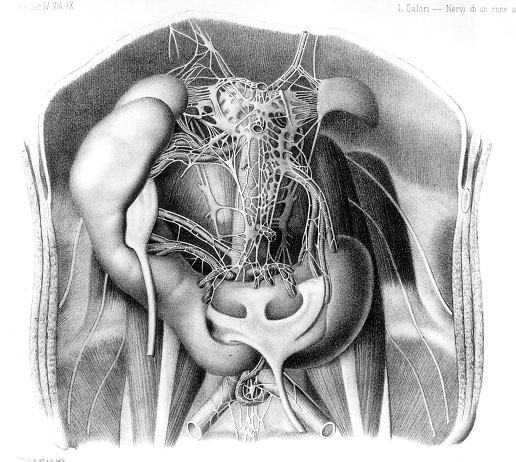
Anatomy Atlases. Immagine ospitata dal sito d’origine. Apri la pagina originale.
Riferimenti dell’opera originale
Elenco riportato come compare nella fonte, senza normalizzazione dei formati bibliografici.
- Bardeen, C.R. and A.W. Elting. (1901) A statistical study of the variations in the formation and position of the lumbo-sacral plexus in man. Anat. Anz. 19:124-128, 209-232.
- Eisler, P. (1892) Der Plexus lumbosacralis des Menschen. Halle.
- Jamieson, E.B. (1903) Some anomalies in nerves arising from the lumbosacral plexus, and a bilaminar musculus pectineus in a foetus; and on variations in the nerve supply in man and in some other mammals. J. Anat. Physiol. 37:266-286.
- Rigaud, A., Cabanie, H., Djussieu, J and J. Plessis. (1955) Note sur la fréquente asymétrie des plexus lombaires. Assoc. Anatomistes Comptes Rendus 42:1206-1214.
- Urbanowicz, Z. (1981) Connections between the lumbar and the sacral plexus in man. Folia Morphol. (Warsaw) 40:271-279.
- Urbanowicz, Z. and S. Zaluska (1969) Formation of the lumbar plexus in man and macaca. Folia Morphol. (Warsaw) 28:256-271.
- Webber, R.H. (1961) Some variations in the lumbar plexus of nerves in man. Acta Anat. 44:336-345.
Classificazione anatomica
- Sistemi:
- Sistema nervoso
Provenienza del contenuto
Adattamento
Adattamento di «Lumbar Plexus — Illustrated Encyclopedia of Human Anatomic Variation: Opus I: Muscular System» di Ronald A. Bergman, Adel K. Afifi, Ryosuke Miyauchi. Fonte: https://www.anatomyatlases.org/AnatomicVariants/NervousSystem/Text/LumbarPlexus.shtml Opera originale distribuita con licenza CC BY-NC-SA 4.0 (https://creativecommons.org/licenses/by-nc-sa/4.0/deed.it). Adattamento a cura di Redazione AIVA. Modifiche rispetto all’originale: Testo originale inglese riprodotto integralmente e riorganizzato nel formato scheda del portale (sintesi, testo, riferimenti), senza modificarne le affermazioni. La traduzione italiana non è ancora stata eseguita, e la pagina lo dichiara. Le figure non sono state copiate: sono collegate alla pagina d’origine. Questa pubblicazione non è approvata né avallata dagli autori dell’opera originale.
Licenza
Questo contenuto è distribuito con licenza CC BY-NC-SA 4.0. Licenze e attribuzioni