Voce enciclopedica
Arterie cerebellare antero-inferiore e cerebellare postero-inferiore
Abstract
Una delle arterie cerebellari antero-inferiore o postero-inferiore può mancare; la cerebellare postero-inferiore può originare dalla carotide interna, dall'arteria meningea posteriore o da diverse porzioni dell'arteria basilare, ed è stata descritta anche duplicata.
Una delle arterie antero-inferiori o postero-inferiori può mancare.
Occasionalmente una delle arterie cerebellari antero-inferiori origina dall'arteria cerebellare posteriore.
L'arteria cerebellare postero-inferiore può fornire l'arteria spinale posteriore.
L'arteria cerebellare postero-inferiore può originare dall'arteria carotide interna e la spiegazione embriologica postulata è la persistenza di un vaso comunicante primitivo (arteria presegmentale) fra la circolazione anteriore e quella posteriore.
L'arteria cerebellare postero-inferiore può originare dall'arteria meningea posteriore.
In uno studio è stata valutata l'incidenza delle arterie cerebellari originanti direttamente dall'arteria carotide interna. Fra 5.500 studi angiografici esaminati sono state trovate undici arterie cerebellari originanti direttamente dalla carotide interna. Sono state inoltre trovate nove arterie cerebrali embrionali. Gli autori ricordano che esistono quattro arterie cerebrali embrionali che collegano direttamente le arterie carotide e basilare: la trigeminale, l'otica, l'ipoglossale e la proatlantoidea. Quella che persiste più frequentemente è l'arteria trigeminale primitiva, con un'incidenza dello 0,2% negli angiogrammi cerebrali. Le undici arterie cerebellari originanti dall'arteria carotide interna sono state considerate varianti di arteria trigeminale primitiva persistente.
L'origine più frequente dell'arteria cerebellare postero-inferiore è dal segmento intracranico dell'arteria vertebrale. Secondo Ahuja e coll. ciò si verifica nel 61% dei casi. Questa origine dell'arteria cerebellare postero-inferiore non è considerata rara.
Questa arteria origina dal terzo superiore dell'arteria basilare nel 2% dei casi, dal terzo medio nel 46% e dal terzo inferiore nel 52% dei casi (Brunner, 1978). Brunner ha inoltre trovato il vaso duplicato nell'11,1%.
Sunderland (1948) riportò che l'arteria cerebellare antero-inferiore decorreva basalmente rispetto al nervo abducente sul lato destro nell'84% e sul lato sinistro nel 73%; Stopford (1915) trovò questa disposizione sul lato destro nell'86% e sul lato sinistro nell'81%. In tre casi Sunderland trovò che l'arteria cerebellare antero-inferiore attraversava il nervo abducente sul lato sinistro. In 16 dei 260 casi di Sunderland (1948) il nervo abducente era profondamente inciso dall'arteria nella parte basale del suo decorso, senza effetti sfavorevoli.
Trigeminale, Intersegmentale cervicalis, Intersegmentale proatlantica, Otica
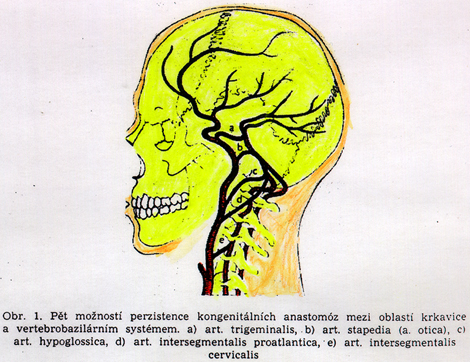
Anatomy Atlases. Immagine ospitata dal sito d’origine. Apri la pagina originale.
Riferimenti dell’opera originale
Elenco riportato come compare nella fonte, senza normalizzazione dei formati bibliografici. Le voci non sono tradotte: un riferimento bibliografico si cita nella lingua in cui è pubblicato.
- Ahuja, A., Graves, V.B., Crosby, D.L. and C.M. Strother. (1992) Anomalous origin of the posterior inferior cerebellar artery from the internal carotid artery. Am. J. Neuroradiology (AJNR) 13:1625-1626.
- Anson, B.J., Ed. (1966) Morris' Human Anatomy, 12th ed., The Blakiston Division, McGraw-Hill Book Company, New York.
- Atkinson, W.J. (1949) The anterior inferior cerebellar artery. Its variations, pontine distribution, and significance in the surgery of cerebello-pontine angle tumors. J. Neurol. Neurosurg. Psychiatry 12:137-151.
- Beevor, C.E. (1908) Cerebral blood supply. Brain 30:403-425.
- Bergman, R.A., Thompson, S.A., Affifi, A.K. and F.A. Saadeh. (1988) Compendium of Human Anatomic Variation: Catalog, Atlas and World Literature., Urban & Schwarzenberg, Baltimore and Munich.
- Bingham, W.G. and G.J. Hayes. (1961) Persistent carotid -basilar anastomosis. J. Neurosurg. 18:398-400.
- Cambell, R.L. and M.L. Dyken (1961) Four cases of carotid-basilar anastomosis associated with central nervous system dysfunction. J. Neuro. Neurosurg. Psychiat. 24:250-253.
- Chambers, A.A. and R. Lukin. (1975) Trigeminal artery connection to the posterior inferior cerebellar arteries. Neuroradiology 9:121-123.
- Dechaume, J.P., Lévy, A., Kofmen, J., et al. (1966) A propos des anastomoses carotidobasilaires anormales. Considérations cliniques et radiologiques. Neuro-chirurgie 12:777-788.
- Dickmann, G.H., Pardal, C., Amezúa, L. et O. Zamboni. (1967) Persistencia de la arteria trigeminal. Acta Neurochir. 17:205-216.
- Distelmaier, P. and J. Wappenschmidt. (1976) An atypical termination of the vertebral artery and of the inferior posterior cerebellar artery. Forschritte Röntgenstrahlen. 124(3):253-256.
- Flesch, M. (1876) Varietäten-Beobachtungen aus dem Präparirsaal zu Wurzburg in der zeit vom 1. Februar 1874 bis 1. April 1875. Verhandlungen der Physikalisch-Medicinische Gesellschaft in Wurzburg 10:25-62.
- Gécs, G., und G. Poór. (1971) Möglichkeit von "steal" - mechanismus beim Vorliegen einer Arteria trigemina primitiva. Z. Neurol. 200:326-336.
- Gelmers, H.J. (1981) On the clinical significance of a persistent trigeminal artery in patients with stroke. Neurochirurgia, Stuttgart 24:103-105.
- Guerrier, Y. and G. Villaceque. (1949) Origine et comportement des artères cérébelleuse moyenne et auditive interne. Assoc. Anatomistes, Comptes Rendus 36:377-382.
- Guerrier, Y. and J. Olivier. (1951) A propos de l'origine des artères cérébelleuses. Assoc. Anatomistes, Comptes Rendus 38:576-579.
- Harrison, C.R. and C. Luttrell. (1953) Persistent carotid-basilar anastomosis. Three arteriographically demonstrated cases with one anatomical specimen. J. Neurosurg. 10:205-215.
- Kaplan, H.A. and D.H. Ford. (1966) The Brain Vascular System. Elsevier, Amsterdam.
- Kempe, L.G. and D.R. Smith (1969) Trigeminal neuralgie, facial spasm, entermedius and glossopharyngeal neuralgia with persistent carotid-basilar anastomosis. J. Neurosurg. 31:445-451.
- Kielbasinski, G. (1976) Arteries of the inferior part of the vermis cerebelli in man. Folia Morphol., Warsaw 35:149-157.
- Kielbasinski, G. (1977) Course and area supplied by the anterior inferior cerebellar arteries in man. Folia Morphol., Warsaw 36:181-190.
- Kos, S. und J. Kos. (1975) Anatomicky nález perzistující arteria trigeminalis primitiva. Cs. Neurol. Neurochir, 38:30-33.
- Lahl, R. (1966) Carotido-basiläre Anastomose (A. primitiva trigeminal) in Kombination mit Anomalien des Circulus arteriosus cerebri. Autopischer Bericht über 4 Fälle. Psychiat. et Neurol., Basel 151:351-365.
- Latarjet, A. (1948) Testut's Traite d'Anatomie Humaine, 9th ed. G. Doin & Cie. Paris.
- Lazorthes, G., Poulhès, J. and J. Espagno. (1950) Les artères du cervelet. Assoc. Anatomistes, Comptes Rendus 37:279-288.
- Lazorthes, G., Poulhès, J. and J. Espagno. (1950) Les territoires vasculaires du cortex cérébellaux. Assoc. Anatomistes, Comptes Rendus. 37:289-297.
- Lie, T.A. (1972) Persistent carotid-basilar and carotid vertebral anatomoses. In: Handbook of Clinical Neurology. Vol. 12 Vascular diseases of the nervous system. Part II, (Eds. Vinken and Bruyn), North Holland Publishing Company, Amsterdam, pp.311-335.
- Madonick, M.J. and A.P. Ruskin (1962) Recurrent oculomotor paresis. Paresis associated with a vascular anomaly, carotid-basilar anastomosis. Arch. Neurol. 6:353-357.
- Marry, G.S. and F.G. Jamieson. (1977) Operative approach to persistent trigeminal artery producing facial pain and diplopia. J. Neurosurg. 47:613-618.
- Mracek, Z., Janda,J. and I. Koranda. (1982) Perzistujici arteria trigeminalis primitiva. Klinická a angiografická studie s anatomickou verifikací. Ceskoslovenská Neurologie a Neurochirurgie 45:345-351.
- Murtaugh, F., Stauffer, H.M. and R.D. Hartley. (1955) A case of persistent carotid-basilar anastomosis associated with aneurysm of the homolateral middle cerebral artery associated with aneurysm of the homolateral middle cerebral artery manifested by oculomotor palsy. J. Neurosurg. 12: 46-49.
- Nadjmi, M. (1961) über die Arteria primitiva trigemini im Carotis- und Vertebralis- angiogramm. Dtsch. Z. Nervenheilkunde 182:231-237.
- Ogawa, T., Fujita, H., Inugami, A., Shishido, F. and K. Higano. (1991) Anomalous origin of the posterior inferior cerebellar artery from the posterior meningeal artery. Am. J. Neuroradiology (AJNR) 12:186.
- Padget, D.H. (1948) The development of the cranial arteries in the human embryo. Carnegie Contributions to Embryology 32:205-261.
- Parkinson, D. and Ch.B. Shields. (1974) Persistent trigeminal artery: Its relationship to the normal branches of the cavernous carotid. J. Neurosurg. 39:244-248.
- Poynter, C.W.M. (1922) Congenital Anomalies of the Arteries and Veins of the Human Body with Bibliography. The University Studies of the University of Nebraska, Lincoln 22:1-106.
- Samra, K., Scoville, W.B. and M.Yaghmai. (1969) Anastomosis of carotid and basilar arteries. Persistent primitive trigeminal artery and hypoglossal artery: Report of two cases. J. Neurosurg. 30:662-625.
- Schaerer, J.P. (1955) A case of carotid-basilar anastomosis with multiple associated cerebrovascular anomalie. J. Neurosurg. 12:62-65.
- Siqueira, M., Piske, R., Ono, M. and R. Marino, Jr. (1993) Cerebellar arteries originating from the internal carotid artery. Am. J. Neuroradiology (AJNR) 14:1229-1235.
- Stern, J., Correll, J.W. and N. Bryan. (1978) Persistent hypogossal artery and persistent trigeminal artery presenting with posterior fossa transient ischemic attacks. J. Neurosurg. 49:614-619.
- Takahashi, M., Wiison, G. and W. Hanafee. (1968) The anterior inferior cerebellar artery: its radiologic anatomy and significance in the diagnosis of extra-axial tumors of the posterior fossa. Radiology 90:281-287.
- Tanohata, K., Maehara, T., Noda, M., Sugiyama, S. and A. Okazaki. (1987) Anomalous origin of the posterior meningeal artery from the lateral medullary segment of the posterior inferior cerebellar artery. Neuroradiology 29:89-92.
- Tsukamoto, S., Hori, Y., Utsumi, S., Tanigake, T., Horiike, N. and R. Otani. (1981) Proatlantal intersegmental artery with absence of bilateral vertebral arteries. J. Neurosurg. 54:122-124.
- Waddington, M.M. (1974) Atlas of Cerebral Angiography with Anatomic Correlation. Little, Brown and Co., Boston.
- Waller, F.T., Simons, R.L., Kerber, C., Kiesel, I.O. and C.T. Tanabe. (1977) Trigeminal artery and microemboli to the brain stem. J. Neurosurg. 46:104-106.
- Wise, B.L. and A.J. Palubinskas. (1964) Persistent trigeminal artery (carotid-basilar anastomosis). J. Neurosurg. 21:199-206.
- Wolf, B.S., Newman, C.M. and M.T. Khilnani. (1962) The posterior inferior cerebellar artery on vertebral angiography. Am. J. Roentgenol. 87:322-337.
Classificazione anatomica
- Sistemi:
- Sistema cardiovascolare
Provenienza del contenuto
Traduzione
Traduzione italiana di «Anterior Inferior Cerebellar and Posterior Inferior Cerebellar Arteries — Illustrated Encyclopedia of Human Anatomic Variation: Opus I: Muscular System» di Ronald A. Bergman, Adel K. Afifi, Ryosuke Miyauchi. Fonte: https://www.anatomyatlases.org/AnatomicVariants/Cardiovascular/Text/Arteries/CerebellarAntPostInferior.shtml Opera originale distribuita con licenza CC BY-NC-SA 4.0 (https://creativecommons.org/licenses/by-nc-sa/4.0/deed.it). Traduzione a cura di Redazione AIVA. Modifiche rispetto all’originale: Traduzione italiana del testo originale inglese, che resta consultabile nella versione inglese di questa pagina. Il contenuto è stato riorganizzato nel formato scheda del portale (sintesi, testo, riferimenti) senza modificarne le affermazioni. Le figure non sono state copiate: sono collegate alla pagina d’origine. Questa pubblicazione non è approvata né avallata dagli autori dell’opera originale.
Licenza
Questo contenuto è distribuito con licenza CC BY-NC-SA 4.0. Licenze e attribuzioni
