Voce enciclopedica
Nervo mediano
Abstract
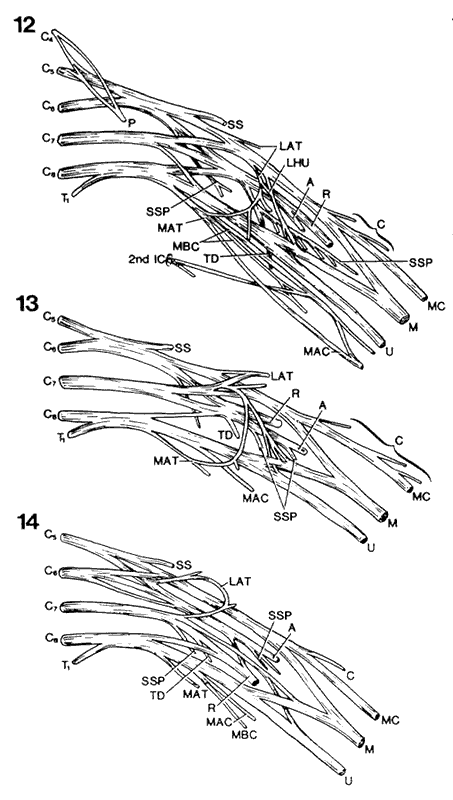
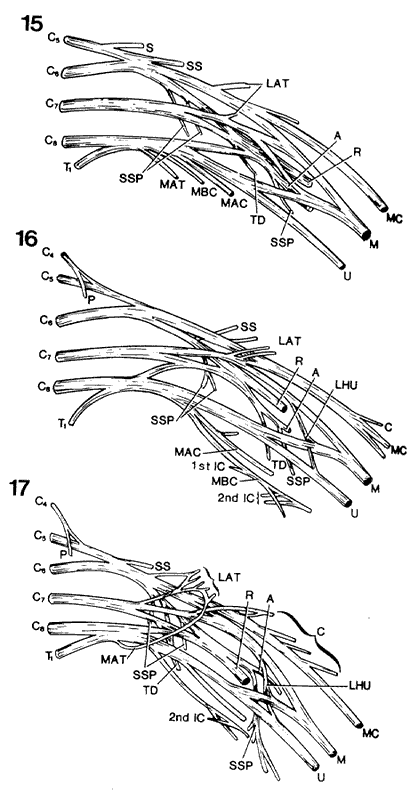
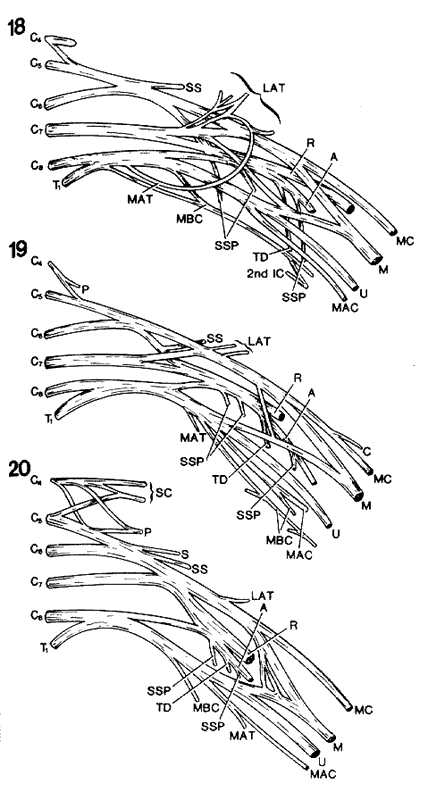
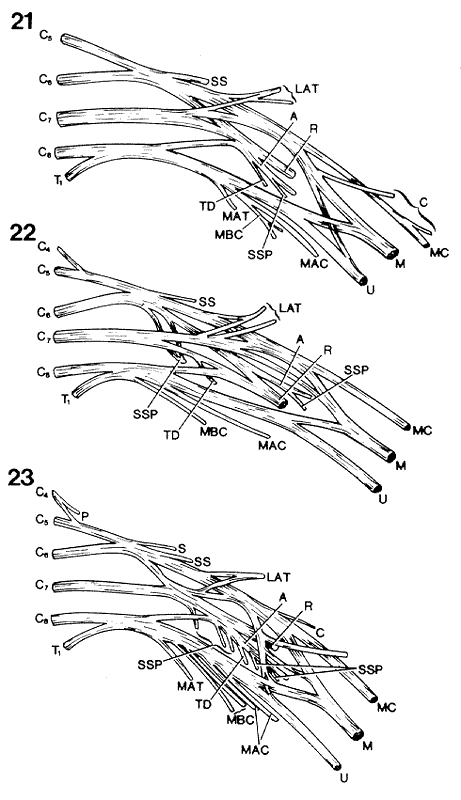
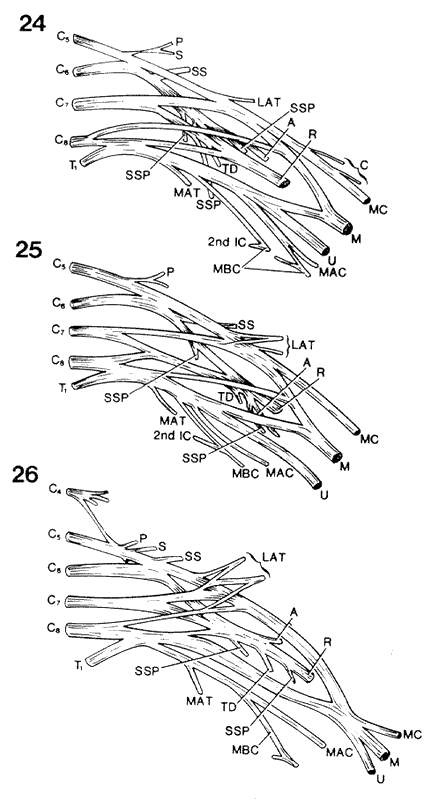
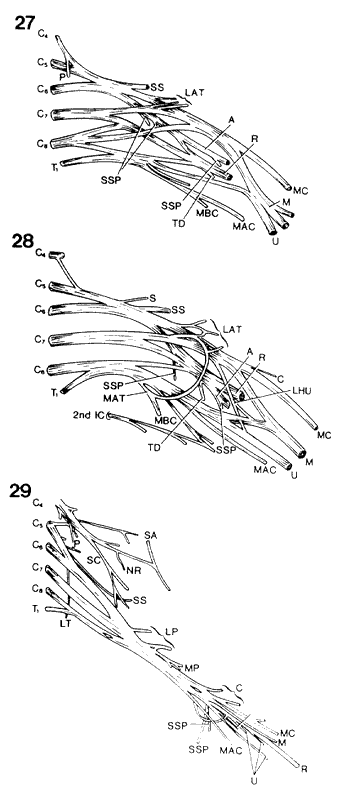
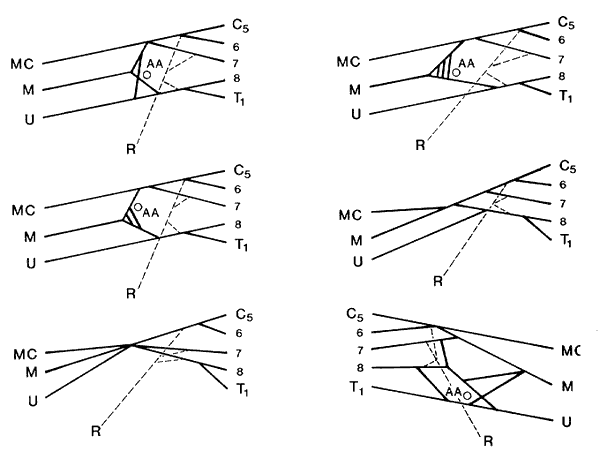
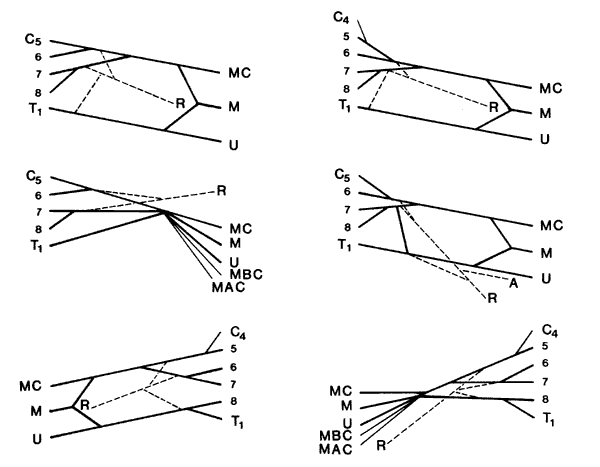
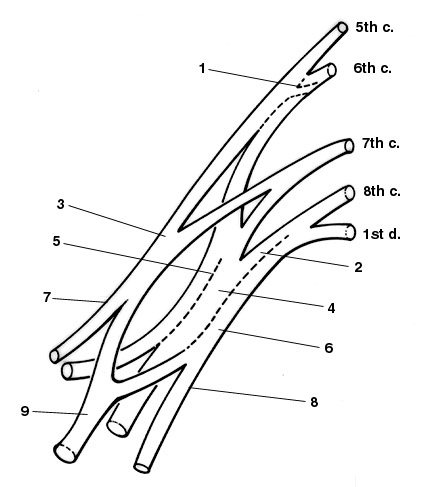
Il nervo mediano varia ampiamente per formazione, decorso e distribuzione: i suoi rami di origine possono essere sdoppiati e unirsi fino a livello del gomito, il nervo può decorrere dietro l’arteria ascellare o brachiale, scindersi nell’avambraccio e attraversare il tunnel carpale in compartimenti separati; sono descritte numerose comunicazioni con il nervo ulnare e una classificazione delle anomalie nel tunnel carpale.
Sono state riportate le variazioni seguenti nella formazione, nel decorso e nella distribuzione di questo nervo. Il contributo del primo nervo toracico alla formazione del nervo mediano può mancare.
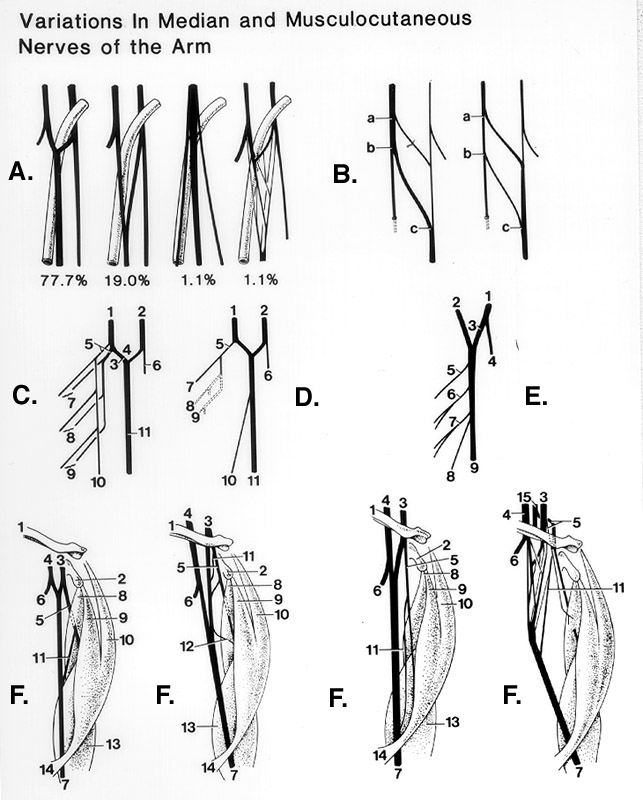
Il ramo esterno (laterale) o quello interno (mediale) del nervo (provenienti rispettivamente dal fascicolo laterale e da quello mediale) può essere costituito da due fasci nervosi.
La sede di unione fra il ramo laterale e quello mediale è assai variabile ed è stata riscontrata fin giù a livello del gomito.
I due rami possono circondare la vena ascellare oltre all’arteria ascellare.
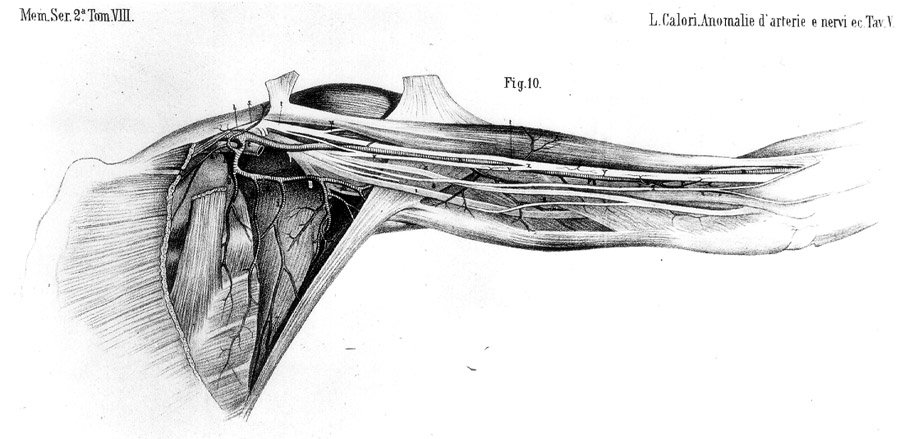
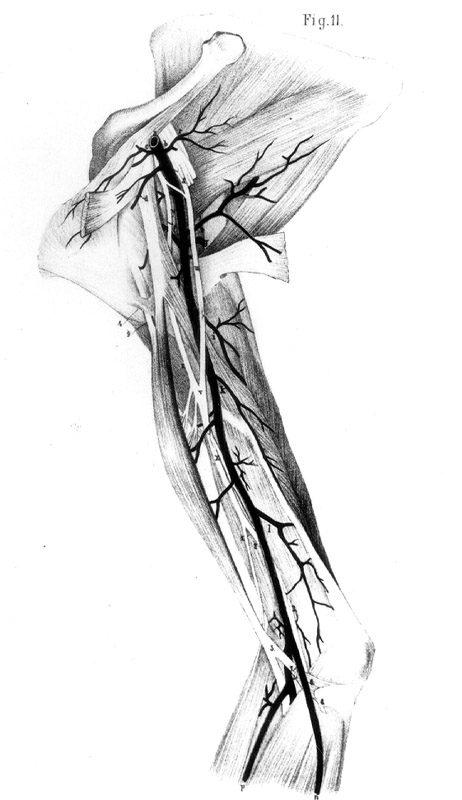
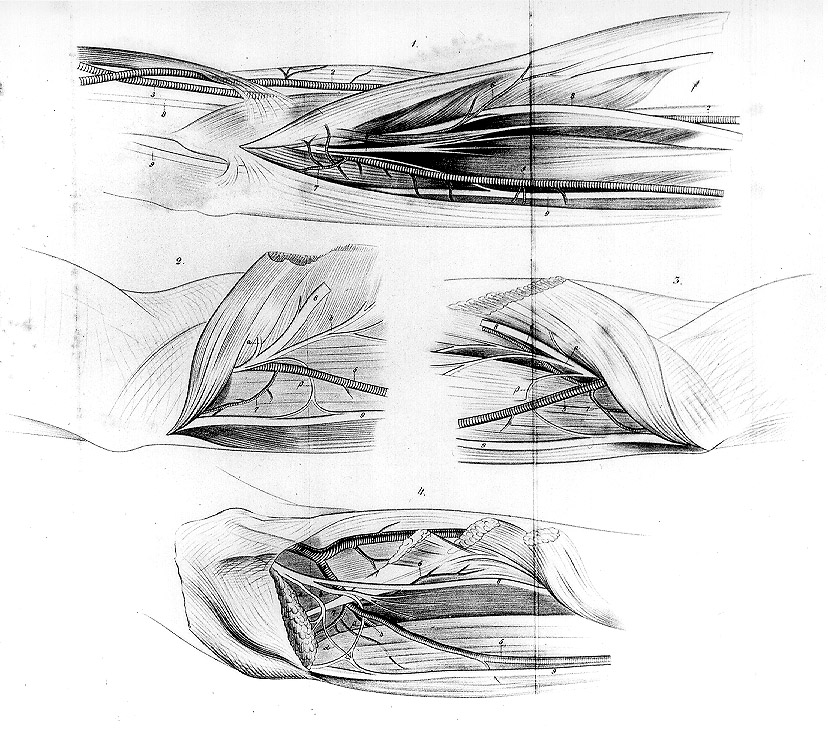
Il nervo mediano o uno dei suoi rami può passare dietro l’arteria ascellare anziché davanti a essa; il nervo può inoltre passare dietro l’arteria brachiale.
Il ramo laterale del nervo talvolta origina a metà del braccio, dietro l’arteria ascellare, e si unisce al ramo mediale.
Il nervo mediano passa di norma fra i due capi del muscolo pronatore rotondo. Può inoltre passare superficialmente o profondamente ai due capi, oppure può perforare il capo omerale. Il nervo può disporsi sulla faccia superficiale del flessore superficiale delle dita anziché profondamente a esso. In alcuni casi il mediano si scinde, formando una fessura nell’avambraccio che consente il passaggio dell’arteria ulnare o di uno dei suoi rami, del capo lungo superficiale del flessore del pollice o di un muscolo palmare lungo sovrannumerario. Il nervo diviso può attraversare il tunnel carpale in compartimenti separati.
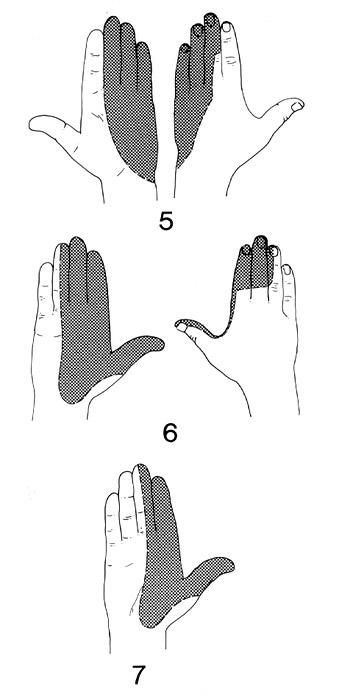
Sono state descritte comunicazioni fra il nervo mediano e il nervo ulnare nel braccio, nell’avambraccio o nella mano. È riportato che fino al 90% dei soggetti studiati presenta anastomosi fra nervo mediano e nervo ulnare, il 10% delle quali bilaterali. In altri studi (per esempio Thomson, J. Anat. 69:159-164) il valore comunemente indicato è del 15% (63 arti superiori su 406). Nello studio di Thomson, le comunicazioni fra gli interossei anteriori si verificavano nell’8% (33 casi); fra i tronchi mediano e ulnare nel 3% (12 casi); fra i rami muscolari del mediano e dell’ulnare nel 4% (16 casi) e mediante un ramo superficiale fra mediano e ulnare nello 0,5% (2 casi). Esse sono riportate più frequentemente sul lato destro. Queste anastomosi mediano-ulnari possono portare fibre nervose a muscoli della mano abitualmente innervati dal nervo ulnare. Il muscolo opponente del pollice può essere innervato sia dall’ulnare sia dal mediano (30% dei casi). Il capo superficiale del flessore breve del pollice (flexor pollicis brevis) è molto frequentemente (83% dei casi) innervato sia dal mediano sia dall’ulnare, e in circa il 25% dei casi dal solo ulnare.
Le anastomosi di Martin-Gruber si verificano nei casi in cui assoni motori abitualmente destinati al nervo ulnare proseguono dal fascicolo mediale nel nervo mediano. Queste anastomosi furono menzionate da Verchère come opera di Rolando Martin, in De nerv. corp. hum., Holmiae et Lipsiae, 1781, secto secunda, p. 216; da Gruber, in Arch. für Anat., 1870, p. 501; da Letiévant, in Soc. chir., Paris, 1867 et in Traité des sections nerveuses., Paris, 1873, p. 45; da Frantz Glénard; da Audibert et Savy, nel Bull. de la Soc. des conf. anat. de Lyon; e da Henle, nel suo classico trattato Handb. der Nervenlehre, 1879, p. 549.
È stato descritto il ramo interosseo anteriore del nervo mediano diretto al muscolo abduttore dell’indice e al primo muscolo interosseo dorsale (3% degli individui). Il terzo, il quarto e il quinto ramo digitale comune del mediano possono originare nell’avambraccio prossimale ed entrare nella mano indipendentemente. Il nervo interosseo anteriore e quello posteriore possono comunicare all’estremità inferiore dello spazio interosseo.
Il mediano può comunicare con il nervo muscolocutaneo. Nel 50% degli individui la porzione del flessore profondo delle dita destinata all’indice e al dito medio è innervata dal nervo mediano, mentre la porzione destinata all’anulare e al mignolo è innervata dall’ulnare. Il nervo mediano può estendersi sulla porzione del muscolo innervata dal nervo ulnare. Solo raramente il nervo ulnare si estende a innervare la porzione del flessore profondo delle dita destinata al dito medio (margine distale mediale).
Il nervo mediano può innervare, in parte, i muscoli bicipite brachiale e brachiale.
Occasionalmente il nervo mediano (e l’arteria brachiale) attraversa un canale formato da un processo sopracondiloideo e da un legamento, dove può (possono) subire compressione, con comparsa di sintomi clinici.
Un nervo mediano è stato trovato penetrare nel ventre del flessore superficiale delle dita, sul suo lato laterale, ed emergere dal suo tendine (quello per l’indice) circa 25 mm al di sopra dell’articolazione del polso.
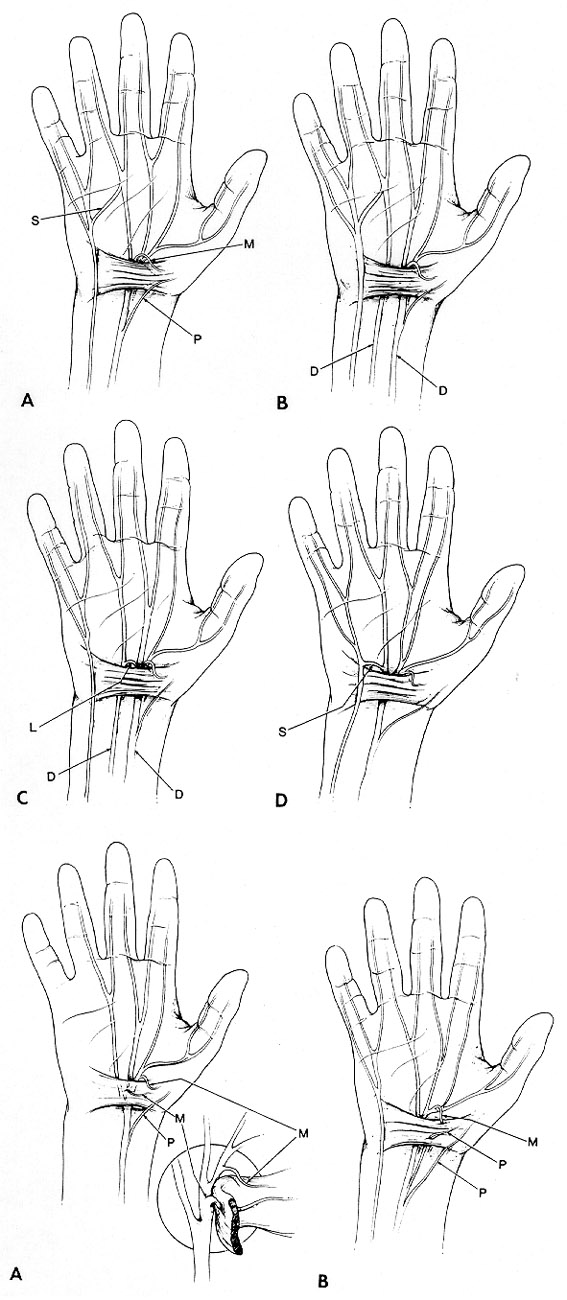
Il nervo mediano può passare nella mano all’interno del retinacolo dei flessori, dove può anche dare origine al ramo motore ricorrente. Il ramo ricorrente può inoltre originare al di sopra del retinacolo oppure attraversarlo per raggiungere i muscoli dell’eminenza tenar.
Classificazione delle anomalie del nervo mediano nel tunnel carpale (dalla piega di flessione del polso all’arcata palmare superficiale) (da Amadio)
Tipo
Incidenza approssimativa in 275 interventi di liberazione del tunnel carpale.
Divisione alta
3 Ramificazione aperta
2 Ansa chiusa
<1
Ramo motore
19 Transretinacolare
15 Multiplo
2 Multiplo e transretinacolare
2
Ramo cutaneo palmare
2,5 Transretinacolare
2,5 Multiplo
0 Multiplo e transretinacolare
0
Ramo sensitivo mediano-ulnare (originante dal nervo mediano prossimalmente all’arcata superficiale)
1
Non classificato
0
Il nervo mediano può essere perforato dall’arteria mediana, quando questa è presente.
Le anastomosi di Riche-Cannieu (fra nervo mediano e nervo ulnare nel palmo della mano) possono esistere nel 70% degli individui. Le anastomosi di Martin-Gruber (fra nervo mediano e nervo ulnare) nell’avambraccio hanno una frequenza riportata del 15%. Va ricordato che le «anastomosi» si verificano fra i nervi mediano, ulnare, radiale e muscolocutaneo, così come fra altri nervi. Si tratta di errori nella via (nel decorso) di alcune fibre nervose collocate in sede inappropriata. Perché queste fibre nervose raggiungano il loro punto terminale corretto, il fascio di fibre nervose abbandona il tronco inappropriato e si unisce al tronco nervoso proprio. Sia le «anastomosi» di Martin-Gruber sia quelle di Riche-Cannieu sono esempi della correzione, da parte della natura, di fibre nervose situate in vie nervose inappropriate. Un mistero, di certo, queste «anastomosi». Su scala più ampia, il plesso brachiale e i plessi sacrali sono altri esempi di smistamento neuronale.
Immagine 31A Immagine 31B Immagine 31C Immagine 31D Immagine 31E Immagine 31F
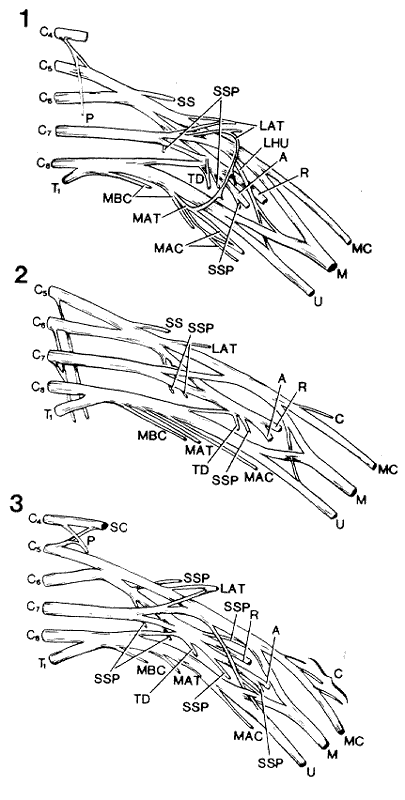
Anatomy Atlases. Immagine ospitata dal sito d’origine. Apri la pagina originale.
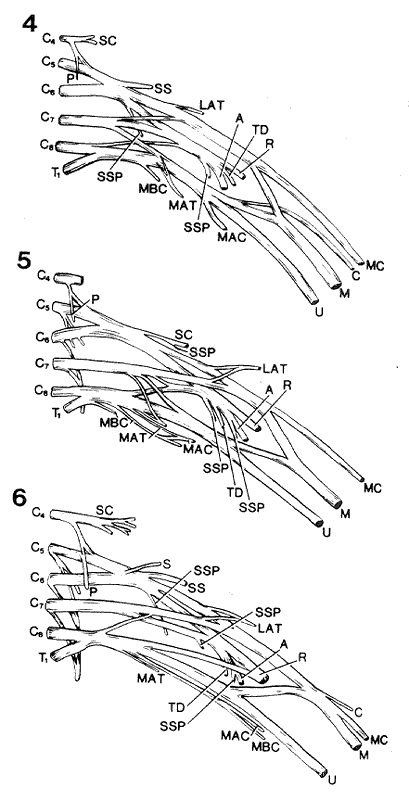
Anatomy Atlases. Immagine ospitata dal sito d’origine. Apri la pagina originale.
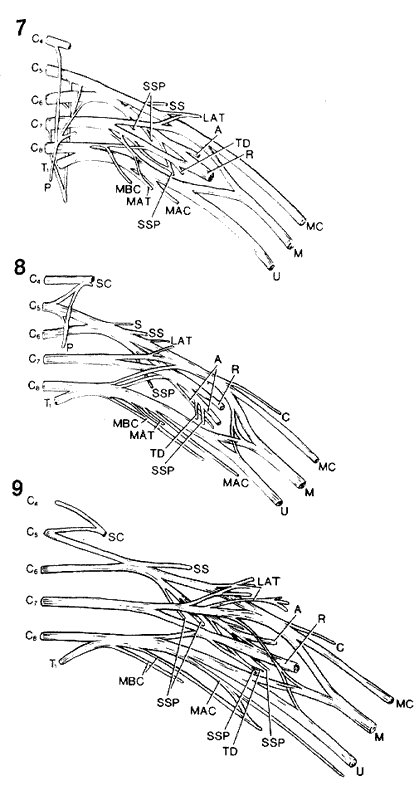
Anatomy Atlases. Immagine ospitata dal sito d’origine. Apri la pagina originale.
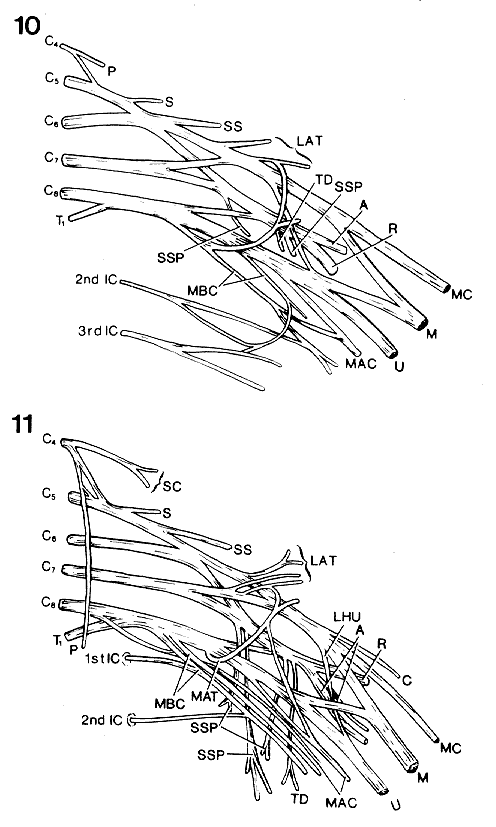
Anatomy Atlases. Immagine ospitata dal sito d’origine. Apri la pagina originale.
Anatomy Atlases. Immagine ospitata dal sito d’origine. Apri la pagina originale.
Anatomy Atlases. Immagine ospitata dal sito d’origine. Apri la pagina originale.
Immagine 31G Immagine 31H Immagine 31I Immagine 31J Immagine 32A
Anatomy Atlases. Immagine ospitata dal sito d’origine. Apri la pagina originale.
Anatomy Atlases. Immagine ospitata dal sito d’origine. Apri la pagina originale.
Anatomy Atlases. Immagine ospitata dal sito d’origine. Apri la pagina originale.
Anatomy Atlases. Immagine ospitata dal sito d’origine. Apri la pagina originale.
Anatomy Atlases. Immagine ospitata dal sito d’origine. Apri la pagina originale.
Immagine 32B Immagine 32C Immagine 32D Immagine 32E Immagine 32F
Anatomy Atlases. Immagine ospitata dal sito d’origine. Apri la pagina originale.
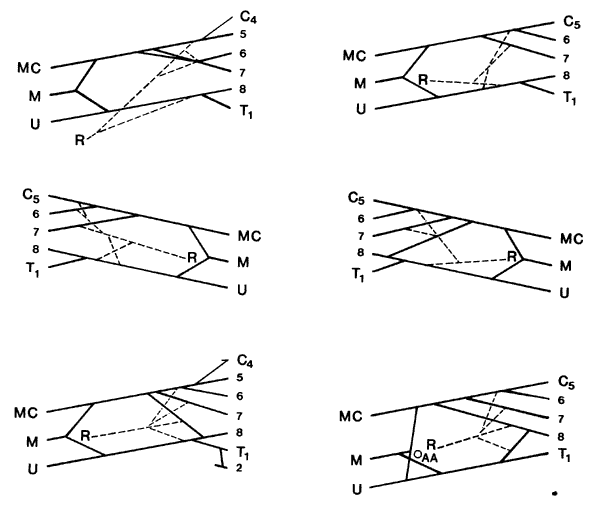
Anatomy Atlases. Immagine ospitata dal sito d’origine. Apri la pagina originale.
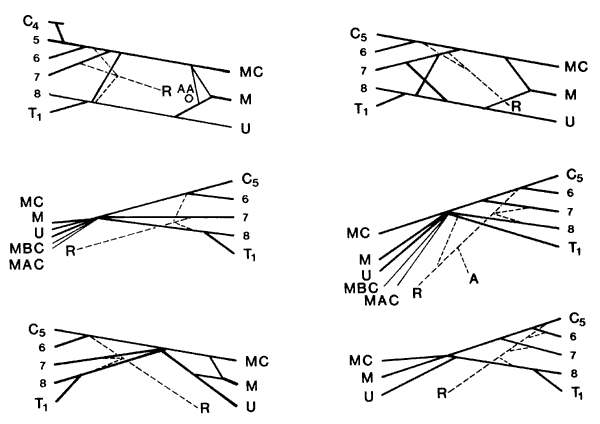
Anatomy Atlases. Immagine ospitata dal sito d’origine. Apri la pagina originale.
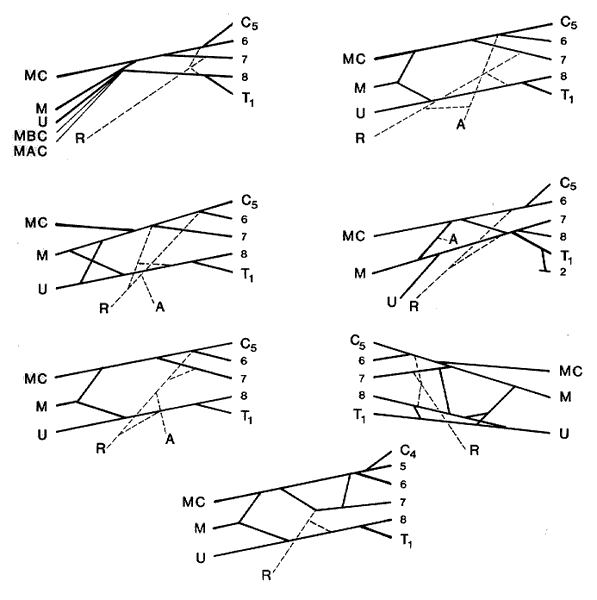
Anatomy Atlases. Immagine ospitata dal sito d’origine. Apri la pagina originale.
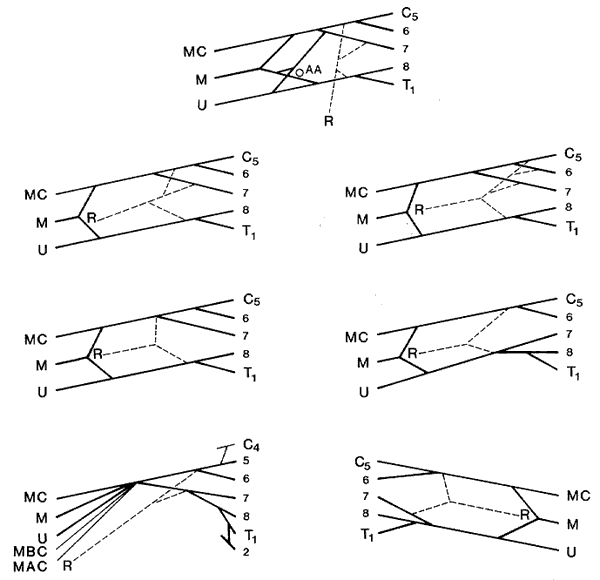
Anatomy Atlases. Immagine ospitata dal sito d’origine. Apri la pagina originale.
Immagine 38A Immagine 38B
Anatomy Atlases. Immagine ospitata dal sito d’origine. Apri la pagina originale.
Anatomy Atlases. Immagine ospitata dal sito d’origine. Apri la pagina originale.
Anatomy Atlases. Immagine ospitata dal sito d’origine. Apri la pagina originale.
Anatomy Atlases. Immagine ospitata dal sito d’origine. Apri la pagina originale.
Anatomy Atlases. Immagine ospitata dal sito d’origine. Apri la pagina originale.
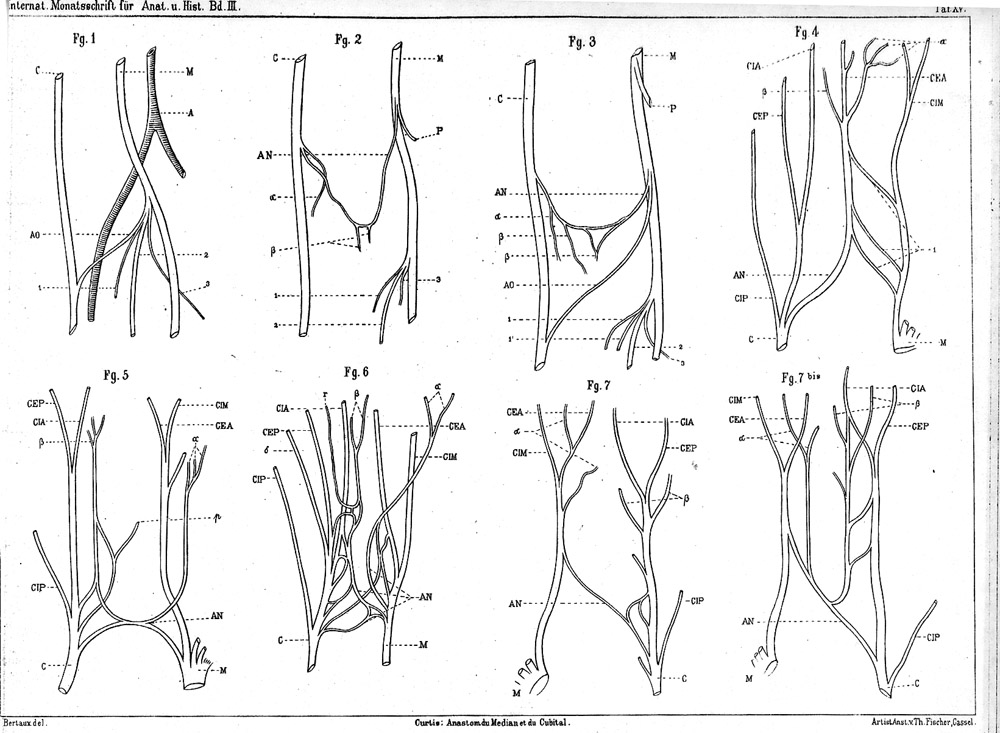
Immagine 50 Immagine 51 Immagine 52A Immagine 52B Immagine 53A Immagine 53B
Anatomy Atlases. Immagine ospitata dal sito d’origine. Apri la pagina originale.
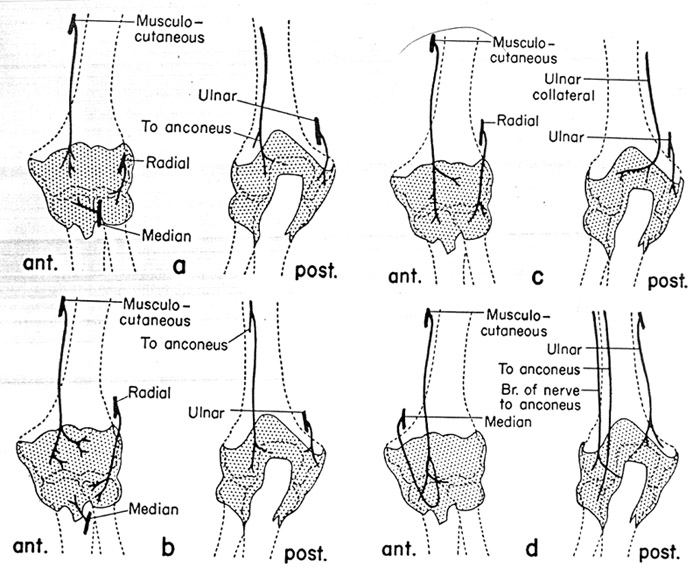
Immagine 50 Immagine 51 Immagine 52A Immagine 52B Immagine 53A Immagine 53B
Anatomy Atlases. Immagine ospitata dal sito d’origine. Apri la pagina originale.
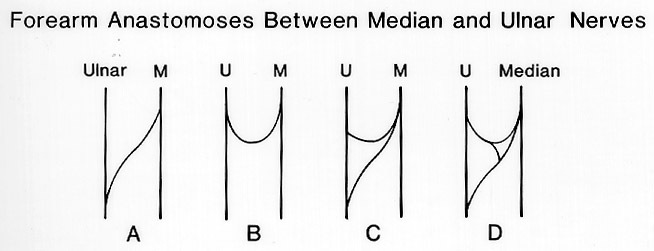
Immagine 50 Immagine 51 Immagine 52A Immagine 52B Immagine 53A Immagine 53B
Anatomy Atlases. Immagine ospitata dal sito d’origine. Apri la pagina originale.
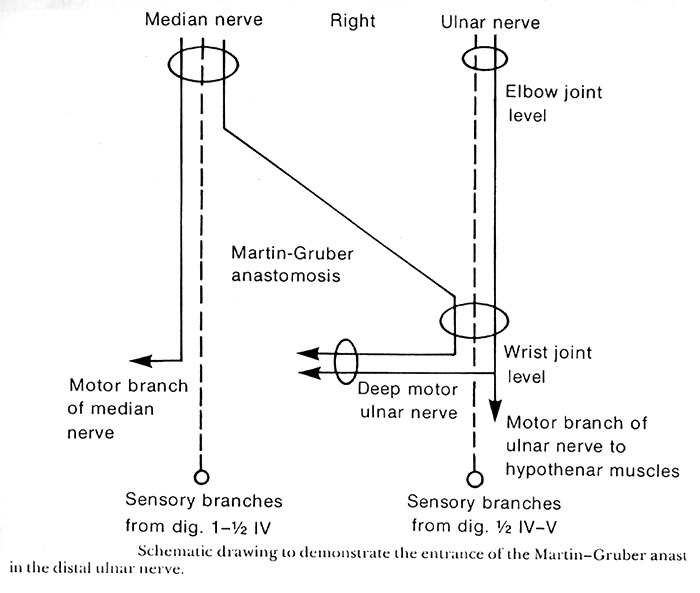
Immagine 50 Immagine 51 Immagine 52A Immagine 52B Immagine 53A Immagine 53B
Anatomy Atlases. Immagine ospitata dal sito d’origine. Apri la pagina originale.
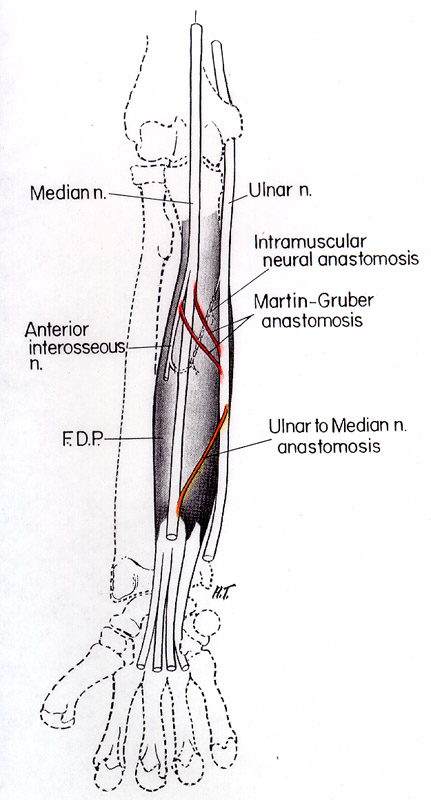
Immagine 50 Immagine 51 Immagine 52A Immagine 52B Immagine 53A Immagine 53B
Anatomy Atlases. Immagine ospitata dal sito d’origine. Apri la pagina originale.
Immagine 62A
Anatomy Atlases. Immagine ospitata dal sito d’origine. Apri la pagina originale.
Anatomy Atlases. Immagine ospitata dal sito d’origine. Apri la pagina originale.
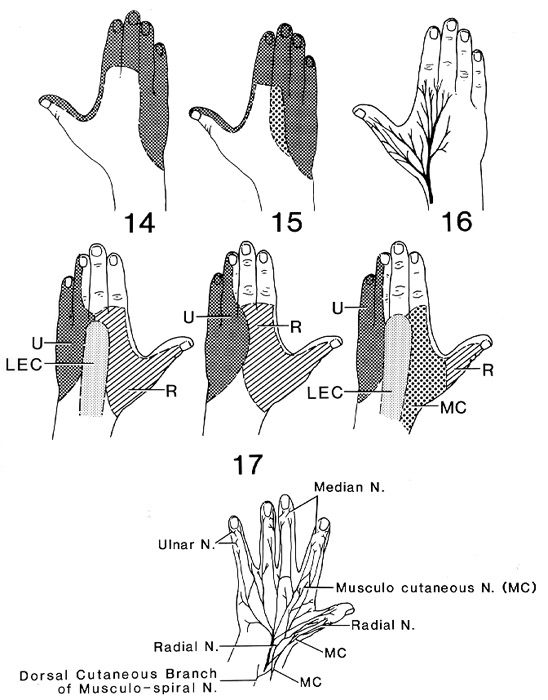
Anatomy Atlases. Immagine ospitata dal sito d’origine. Apri la pagina originale.
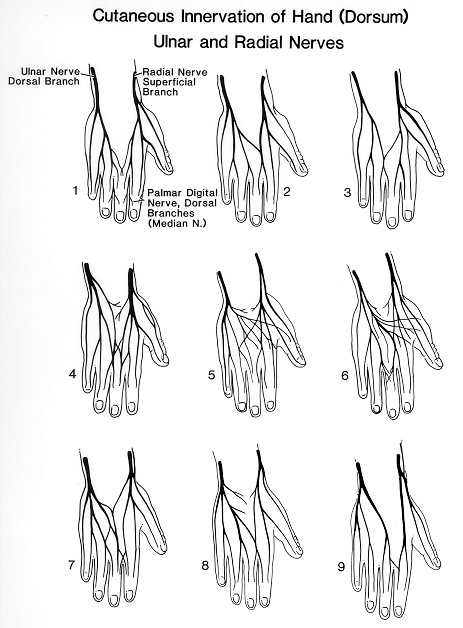
Anatomy Atlases. Immagine ospitata dal sito d’origine. Apri la pagina originale.
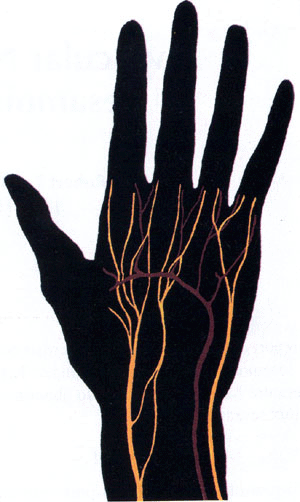
Anatomy Atlases. Immagine ospitata dal sito d’origine. Apri la pagina originale.
Riferimenti dell’opera originale
Elenco riportato come compare nella fonte, senza normalizzazione dei formati bibliografici. Le voci non sono tradotte: un riferimento bibliografico si cita nella lingua in cui è pubblicato.
- Ahn, D.S., Yoon, E.S., Koo, S.H., and S.H. Park. (2000) A prospective study of the anatomic variatiosn of them edian nerve in the carpul tunnel in Asians. Ann. Plast. Surg. 44(3):282-287.
- Ajmani, M.L. (1996) Variations in the motor nerve supply of the thenar and hypothenar muscles of the hand. J. Anat. (189, pt.1):145-150.
- Amadio,P.C. (1987) Bifid median nerve with a double compartment within the transverse carpal canal. J. Hand Surg. (Am.) 12:366-368.
- Amadio, P.C. (1988) Anatomic variations of the median nerve within the carpal tunnel. Clinical Anatomy 1:23-31.
- Anson, B.J., Ed. (1966) Morris' Human Anatomy, 12th ed., The Blakiston Divison, McGraw-Hill Book Company, New York.
- Artico, M., DeSantis, S., Cavallotti, D., and C. Cavallotti. (2000). Anatomical Variations of the ulnar and median nerves in the upper limb. J. Anat. Embryol. 105(3): 189-200.
- Backhouse, K.M. (1975) Innervation of the hand. Hand 7:107-114.
- Barfred, T., Hojlund, A.P. and K. Bertheussen. (1985) Median artery in carpal tunnel syndrome. J. Hand Surg. (Am.) 10:864-867.
- Barta, E. and L. Petrovits. (1927) Das Ligamentum supracondyloideum. Anat. Anz. 63:177-184.
- Baruch, A. and A. Hass. (1977) Anomaly of the median nerve. J. Hand. Surg. (Am.) 2:331-332.
- Bas, H. and J.M. Kleinert. (1999) Anatomic variations in sensory innervation of the hand and digits. J. Hand Surg. (Am) 24(6):1171-1184.
- Beaton, L.E. and B.J. Anson. (1939) The relation of the median nerve to the pronator teres muscle. Anat. Rec. 75:23-26.
- Behiery, E.E. (2004) Anatomical variations of the median nerve distribution and communication in the arm. Folia Morphol. (Warsaw) 53(3):313-318.
- Bennett, J.B. and C.C. Couch. (1982) Compression syndrome of the recurrent motor branch of the median nerve. J. Hand Surg., (Am.) 7:407-409.
- Bergman, R.A., Thompson, S.A., Afifi, A.K. and F.A. Saadeh. (1988) Compendium of Human Anatomic Variation. Munich and Baltimore.
- Blain des Cormiers, -. (1848) Exemple d'anomalie du nerf médian. Bulletins et Mem. de la Société Anatomique de Paris XXII(5,6):129.
- Blair, W.F. and K. Joos. (1982) The innervation of flexor carpi radialis. An interfasicular dissection. Arch. Neurol. 39:647-649.
- Broca, A. (1888) Innervation collaterale et plaies des nerfs. Gazette Hebdomadaire de Médecine et de Chirurgie. S.2., 25(9):129-132.
- Borchardt, M. and -. Wjasmenski. (1917) Der Nervus medianus. Beitr. Klin. Chir. 107:553-582.
- Botman, Y.A. and J. W. Mulder. (2001). Misinterpretation of nerve damage to the hand and forearm due to variations in the motor inservation. Ned. Tydschr. Geneeskd. 145(27):1316-1320. In Dutch.
- Broca, -. (1850) Tendon du petit palmaire perforant le nerf médian. Bulletins et Mem. de la Société Anatomique de Paris XXV(1):5-6.
- Brooks, H. St. J. (1887) Variations in the nerve supply of the lumbrical muscles in the hand and foot, with some observations on the innervation of the perforating flexors. J. Anat. Physiol. 21:575-585.
- Buch, C. (1964) Zur Variation der Innervationweise des M. Biceps brachii unter Beachtung der Astagabe vom N. musculocutaneous und vom N. medianus. Anat. Anz. 114:131-140.
- Buch-Hansen, K. (1955-56) über Varietaten des Nervus medianius und des Nervus musculocutaneous und deren Beziehungen. Anat. Anz. 102:187-203
- Calori, L. (1868) Delle anomalie più importanti di ossa, vasi, nervi, e muscoli occorse nell'ultimo biennio fascendo anatomia del corpo umano. Mem. R. Accad. Sci. Istituto di Bologna S. 2., 8:417-482.
- Calori, L. (1877) Sul variato rapporto vascolare delle due radici del nervo mediano e sulle condizioni atte a produrlo. Mem. R. Accad. Sci Istituto di Bologna S3., 8:443-456.
- Calori, L. (1880) Intorno al canale sopracondiloideo dell'omero nell'umano. Mem. R. Accad. Sci. Istituto di Bologna S. 4., 2:37-46.
- Cannieu, A. (1887) Note sur une anastomose entre le branche profunde de cubital et le median. Bull. Soc. Physiol. Norm. Pathol. (Bordeaux) 17:339-342.
- Carroll, R.E. and D.P. Green. (1972) The significance of the palmar cutaneous nerve at the wrist. Clin. Orthop. 83:24-28.
- Cavalio, A.V., Slattery, P.G., and R.J. Barton. (2003) Endoscopic carpal tunnel release and congenital anomolies of the median nerve. Hand Surg. 8(2):265-270.
- Chaise, F. and J. Witvoet (1983) Les anomalies de division du nerf median. Une observation. Revue de la literature. J. Chir. (Paris) 120:335-336.
- Chabaud,B., Flocard,F., Dasse,Y, Ribot, C., Bady, B., and M. Sindou. (1993) Surgical applications of anatomical variations of the median nerve at the corist. Neurochirurgie 39(2): 92-100. In French.
- Chaput, -. (1886) Note sur deux variétés d'anastomoses nerveuses de l'avant-bras. Bulletins et Memoires de la Société Anatomique de Paris. 1886(6):427-429.
- Cheung, J.W. Shyu, J.F., Teng, C.C., Chen, T.H., Su, C.H., Shyr, Y.M., Wang, J.J., Wu, C.W., Liu, W.Y. and J.C. Liu. The anatomical variations of the palmar cutaneous branch of the median nerve in Chinese adults. J. Chin. Med. Assoc. 67(1):27-31.
- Crandall, R.C. and A.L. Hamel. (1979) Bipartite median nerve at the wrist. J. Bone Joint Surg. (Am) 61:311.
- Curtis, F. (1886) L'anastomose du médian et du cubital. International Monatschrift für Anat. u. Hist. (Leipzig) 3:309-324.
- Dankmeijer, J. and J.M. Waltman. (1950) Sur l'innervation de la face dorsale des doights humains. Acta Anat. 10:377-384.
- Darlin, L.B., Aulicino, P.L., and T.L. Bergfield. (1992) Anatomical variations of the median nerve and the corist. Orthop. Rev. 21(8): 955-959.
- Deville, -. (1843) Anastomose du nerf musculo-cutané avec le nerf median. Bulletins et Mem. de la Société Anatomique de Paris XVIII(10):293.
- DiDio, L.J.A. and J.G. Angelo (1963) Nervus medianus piercing the caput humerale of the m. pronator teres. Anat. Anz. 112:385-388.
- Don Griot, J.P., Van Kooten, E.O., Zuidan, J.H., Prose, L.P., and J.J. Hage. (2002). Internal anatomy of the communicating branch between the ulnar and the median nerves in the hand and it's relevance to volar digital sensibility. J. Hand Surg (Am) 27(1): 143-146.
- Durox, P.E., Barry, P. and P. LaCoste. (1952) Le rameau thenarien du médian. Assoc. Anatomistes Comptes Rendus 39:146-150.
- Duroux, -., Dujol, -., Gabrielle, C. and -. Garde. (1952) Le anomalies du nerf médian. Assoc. Anatomistes Comptes Rendus 39:153-154.
- Eiken, O., Carstam, N. and A. Eddeland (1971) Anomalous distal branching of the median nerve. Case Reports. Scand. J. Plast. Reconstr. Surg. 5:149-152.
- Falconer, D. and M. Spinner. (1985) Anatomic variations in the motor and sensory supply of the thumb. Clin. Orthop. 195:83-96.
- Ferner, H. (1937) Ein abnormer Verlauf des Nervus medianus vor der dem M. pronator teres. Anat. Anz. 84:151-156.
- Fetrow, K.O. (1970) Practical and important variations in sensory nerve supply to the hand. Hand 2(2):178-184.
- Forrest, W.J. (1967) Motor innervation of human thenar and hypothenar muscles in 25 hands: A study combining electromyography and percutaneous nerve stimulation. Can. J. Surg. 10:196-199.
- Graham III, W.P. (1973). Variations of the motor branch of the median nerve at the wrist. Case Report. Plast Reconstr. Surg. 51(1):90-92.
- Gruber, W. (1867) Anomaler Verlauf des Nervus medianus vor dem Musculus pronator teres, bei Durchbohrung des letzteren durch die hoch am Oberarme von der Arteria brachialis entsprungene Arteria interossea. Arch. Anat. Physiol. Wissen Med. 1867:552-559.
- Gruber, W. (1870) über die Verbindung des Nervus medianus mit dem Nervus ulnaris am Unterarme des Menschen und der Saugethiere. Arch. Anat. Physiol. Klin. Med. (Leipzig) 37:501-522.
- Gruber, W. (1881) über eine durch den Theilungswinkel der Arteria brachialis treende Ansa Recurrens zwischen dem Nervus musculocutaneous brachii und dem Nervus medianus beim Menschen. Arch. Pathol. Anat. Physiol. Klin. Med. 86:29-33.
- Gruber, W. (1881) Abgang des Ramus volaris digitorum communis III des Nervus medianus in verschiedener Höhe am Unterarme. Arch. Pathol. Anat. Physiol. Klin. Med. 86:33-35.
- Gunther, S.F., DiPasquale, D., and R. Martin. (1993) Struthers' ligament and associated median nerve variations in a cadaveric specimen. Yale, J.Bio.Med. 66(3):203-208.
- Gutmann, L. (1977) Median-ulnar nerve communications and carpal tunnel syndrome. J. Neurol. Neurosurg. Psychiatry 40:982-986.
- Gutmann, L. (1993) Important anomalous innervations of the extremities. Muscle & Nerve 16:339-347.
- Gutmann, L. (1993) AAEM minimonograph #2: Important anomolous innerrations of the extremities. Muscle Nerve 16(4):339-347.
- Harness, D. and E. Sekeles. (1971) The double anastomotic innervation of thenar muscles. J. Anat. 109:461-466.
- Hartmann, -. (1887) Note sur l'anatomie des nerfs de la paume de main. Bull. et Mém. Soc. Anatomique de Paris 1887(5):860-864.
- Hartmann, -. (1888) Anastomoses elliptiques des nerfs du membre supérieur. Bull. et Mem. Soc. Anatomique de Paris 1888:151.
- Henle, J. (1868) Handbuch der Systematischen Anatomy des Menschen, von Friedrich Vieweg und Sohn, Braunschweig.
- Highet, W.B. (1943) Innervation and function of the thenar muscles. Lancet 1:227-230.
- Hopf, H.C. (1990) Forearm ulnar to median nerve anastomosis of sensory axons. Muscle & Nerve 13:654-656.
- Hurwitz, P.J. (1996) Variations in the course of the thenar motor branch of the median nerve. J. Hand Surg. (Br) 21(3): 344-346.
- Jabaley, M.E., Wallace, W.H. and F.R. Heckler. (1980) Internal topography of major nerves of the forearm and hand: A current view. (1980) J. Hand Surg. 5:1-18.
- Jamieson, R.W. and B.J. Anson. (1952) The relation of the median nerve to the heads of origin of the pronator teres muscle. A study of 300 specimens. Q. Bull. Northwestern University Medical School 26:34-35.
- Johnson, R.K. and M.M. Shrewsbury. (1970) Anatomical course of the thenar branch of the median nerve. J. Bone Joint Surg. (Am) 52:269-273.
- Kessler, I. (1969) Unusual distribution of the median nerve at the wrist. Clin. Orthop. 67:124-126.
- Kitayama, Y., Tsukada, S. and M. Kurokawa. (1985) High division of the median nerve: Unusual anatomical variation. Ann. Plast. Surg. 14:74-76.
- Komar, J., Szegvari, M., Gloviczky, Z. and A. Szantao. (1978) Traumatischer Durchschnitt des N. medianus ohne komplette motorische Parese: Martin-Grubersche Anastomose. Nervenarzt 49:697-699.
- Kopsch, F. (1908) Rauber's Lehrbuch der Anatomie des Menschen. Georg Thieme, Leipzig.
- Kornberg, M., Aulicino, P.L. and T.E. DuPuy. (1983) Bifid median nerve with three thenar branches-case report. J. Hand Surg. (Am) 8:583-584.
- Lanz, U. (1975). Variations of the median nerve at the carpal tunnel. Handchirurgie 7(4):163-164. In German.
- Lanz, U. (1977) Anatomical variations of the median nerve in the carpal tunnel. J. Hand Surg. (Am) 2(1):44-53.
- Latarjet, A. (1948) Testut's Traite d'Anatomie Humaine, 9th ed. G.Doin & Cie., Paris.
- Leinberry, C.F. and M.A. Wehbe. (2004) Brachial plexus anatomy. Hand clin. 20(1):1-5.
- LeMinor, J.M. (1990) A rare variation of the median and musculotaneous nerves in man. Arch. Anat. Histol. Embryol. 73:33-42. In French.
- Lindley, S.G. and J.M. Kleinert. (2003) Prevalence of anatomic variations encountered in elective carpal tunnel release. J. Hand Surg. (A) 28(5):849-855.
- Linell, E.A. (1921) The distribution of nerves in the upper limb, with reference to variabilities and their clinical significance. J. Anat. 55:79-112.
- Lorey, -. (1874) Note sur la distribution des nerfs colletéraux des doigts et sur les sections nerveuses du member supérieur. Bulletins et Mem. de la Société Anatomique de Paris XLIX(7):574-575.
- Luna, E. (1910) Frequente anastomosi tra il nervo ed il ramo volare profondo del nervo cubitale. Anat. Anz. 36:383-384.
- Luna, E. (1911) Frequente anastomose entre le nerf median et le rameau profund du nerf cubital. Arch. Ital. Biol. 55:141.
- Martin, R. (1763) Tal om Nervers allmanna Egenskaper i Manniskans Kropp. L. Salvius, Stockholm.
- Matejcik, V. (2003) Anatomic deviations in the origin of the median nerve. Rozhl. Chir. 10:526-528. In Slovak.
- Matini, K. (1983) Abnormal distribution of the median nerve at the wrist and forearm. Plast. Reconstr. Surg. 71:711-713.
- May, J.W., Jr., and H. Rosen (1981) Division of the sensory ramus communicans between the ulnar and median nerves: A complication following carpal tunnel release. A case report. J. Bone Joint Surg. (Am). 63:836-838.
- Meals, R.A. and M Shaner (1983) Variations in digital sensory patterns: A study of the ulnar nerve-median nerve palmar communicating branch. J. Hand Surg. (Am). 8:411-414.
- Miller, M.R., Ralston, H.J. III., and M. Kasahara. (1958) The pattern of cutaneous innervation of the human heart. Am. J. Anat. 102:183-217.
- Murphey, F., Kirklin, J.W. and A.J. Finlayson. (1946) Anomalous innervation of the intrinsic muscles of the hand. Surg., Gynecol. Obstet. 83:15-23.
- Nakano, K.K. (1978) The entrapment myopathies. Muscle Nerve 1:264-279.
- Ogden, J.A. (1972) An unusual branch of the median nerve. J. Bone Joint Surg. (Am) 54:1779-1781.
- Omer, G.E., Jr. and M. Spinner. (1980) Management of Peripheral Nerve Problems. W.B. Saunders Company, Philadelphia.
- Papathanassiou, B.T. (1968) A variant of the motor branch of the median nerve in the hand. J. Bone Joint Surg. (Br) 50:156-157.
- Phalen, G.S. (1966) The carpal tunnel syndrome. Seventeen year's experience in diagnosis and treatment of six hundred fifty-four hands. J. Bone Joint Surg. (Am) 48:211-228.
- Ranschburg, P. (1917) über die Anastomosen der Nerven der oberen Extremität des Menschen mit Rücksicht auf ihren neurologische und nervenchirurgische Bedeutung. Neurol. Centralblatt 36:521-534.
- Rey, R.C., Sanz, O.P., and R.E. Sica. (1984) Electrophsiological study of the variations of the innervations of the hand muscles. Arq. Neuropsiquiatr. 42(1):14-19. In Spanish.
- Richelot, L.G. (1883) Note sur l'innervation collatérale a propos d'une résection du nerf médian. Bull. et Mém. de la Soc. de Chirurgie de Paris 1883(23Mai):438-466.
- Robbins, H. (1963) Anatomical study of the median nerve in the carpal tunnel and etiologies of the carpal tunnel syndrome. J. Bone Joint Surg. (Am) 45:953-966.
- Rowntree, T. (1949) Anomalous innervation of the hand muscles. J. Bone joint Surg. (Br) 31:505-510.
- Sadr, A.R. (1946) Cross nerve anastomosis in man. Ann. Surg. 124:599-603.
- Sargou, M.F., Uslu, S.S., Celik, H.H., and D. Aksit. (1995) A variation of the median nerve at the level of brachial plexus. Bull. Assoc. Anat (Nancy) 79(246):25-26.
- Schaefer, E.A., Symington, J. and T.H. Bryce., Eds. Quain's Anatomy, 11th ed., Longmans, Green, and Co., London.
- Schultz, R.J., Endler, P.M. and H.D. Huddleston. (1973) Anomalous median nerve and an anomalous muscle belly of the first lumbrical associated with carpal-tunnel syndrome. Case Report. J. Bone Joint Surg. (Am) 55:1744-1746.
- Seradge, H. and E. Seradge. (1990) Median innervated hypothenar muscle: anomalous branch of median nerve in carpal tunnel. J. Hand Surg. (Am) 15:356-359.
- Siegel, J.L., Daulin, L.B., and P.L. Aulicino. (1993) An anatomical variation of the palmar cutaneous branch of the median nerve. J. Hand Surg. (Br) 18(3):182-183.
- Siverhus, S.W., Kremchek, T.E., Smith, W.R., Basch, T.M. and R.L. Drake. (1989) A cadaveric study of anatomic variations of the recurrent motor branch of the median nerve. Orthop. Rev. 18(3):315-320.
- Sokolow, P.A. (1929-30) Abweichungen in dem Verlaufe der Gefässe und Nerven im Zusammenhang mit dem Vorhandensein des Proc. supracondyloideus am Oberarmbein. Anat. Anz. 68:156-163.
- Spinner, M. (1970) The anterior interosseous nerve syndrome with special attention to its variation. J. Bone Joint Surg. (am) 52:84-94.
- Stilwell, D.L., Jr. (1957) The innervation of deep structures of the hand. Am. J. Anat. 101:75-99.
- Stopford, J.S.B. (1919) The variations in distribution of the cutaneous nerves of the hand and digits. J. Anat. 53:14-25.
- Sunderland, S. (1945) The innervation of the flexor digitorum profundus and lumbrical muscles. Anat. Rec. 93:317-321.
- Sunderland, S. (1945) The intraneural topography of the radial, median and ulnar nerves. Brain 68:243-298.
- Sunderland, S. (1946) The innervation of the first dorsal interosseous muscle of the hand. Anat. Rec. 95:7-10.
- Sunderland, S. and L.J. Ray. (1946) Metrical and non-metrical features of the muscular branches of the median nerve. J. Comp. Neurol. 85:191-203.
- Taleisnik, J. (1973) The palmar cutaneous branch of the median nerve and the approach to the carpal tunnel. An anatomical study. J. Bone Joint Surg. (Am) 55:1212-1217.
- Tanzer, R.C. (1959) The carpal-tunnel syndrome. A clinical and anatomical study. J. Bone Joint Surg. (Am) 41:626-634.
- Thompson, I.M. (1922) Anomaly of the median nerve and flexor digitorum sublimis muscle. Anat. Rec. 23:375-379.
- Thompson, I.M. (1934-35) The diagnostic application of our knowledge of the normal variability of cutaneous nerve areas, exemplified by the median and ulnar nerves. J. Anat. 69:159-164.
- Tountas, C.P., MacDonald, C.J., Meyerhof, J.D. and D.H. Bihrle. (1983) Carpal tunnel syndrome. A review of 507 patients. Minn. Med. 66:479-482.
- Tountas, C.P., Bihrle, D.M., MacDonald, C.J. and R.A. Bergman (1987) Variations of the median nerve in the carpal canal. J. Hand Surg. (Am.) 12:708-712.
- Tountas, C.P. and R.A. Bergman. (1992) Anatomic Variations of the Upper Extremity. Churchill-Livingstone, New York.
- Valls-Sole, J. (1991) Martin-Gruber anastomosis and unusual sensory innervation of the fingers: report of a case. Muscle and Nerve 14:1099-1102.
- Verchère, F. (1883) Anastomoses du nerf médian et du nerf cubital à la partie supérieure de l'avant-bras. - Innervation des fléchisseurs. Bulletins et Memoires de la Société Anatomique de Paris. 1883(1):49-52.
- Verdan, C. (1981) Anomalies of muscles and tendons in the hand and wrist. Rev. Chir. Orthop Repartrice Appar. Mot. 67(3):221-230. In French.
- Villar, F. (1887) Anastomose du musculo-cutané et du médian. - Anastomose du médian et du cubital. Bulletins et Memoires de la Société Anatomique de Paris. 1887(4):192-194.
- Villar, F. (1888) Quelques recherches sur les anastomoses des nerfs du membre supérieur. 1) Anastomoses du musculo-cutanéet du médian; 2) Anastomoses du médian et du cubital.; 3) Anastomoses du radial et du cubital. - De leur importance au point de vue du rétablissement des fonctions à la suite des sections nerveuses. Bull. et Mém. de la Soc. Anatomique de Paris 2:607-615.
- Wallace, W.A. and P.A.M. Weston. (1974) The arrangement of the digital nerves within the human thumb and index fingers. J. Anat. 118:381-382.
- Wallace, W.A., and R.E.Coupland. (1975) Variations in the nerves of the thumb and index finger. J.Bone Joint Surg. (Br) 57(4):491-494.
- Wilbourn, A.J. and E.H. Lambert. (1976) The forearm median to ulnar nerve communications: electrodiagnostic aspects. Neurology 26:368.
- Wilson, J.T. (1890) Two cases of variation in the nerve supply of the first lumbrical muscle in the hand. J. Anat. Physiol. 24:22-26.
Classificazione anatomica
- Sistemi:
- Sistema nervoso
Provenienza del contenuto
Traduzione
Traduzione italiana di «Median Nerve — Illustrated Encyclopedia of Human Anatomic Variation: Opus I: Muscular System» di Ronald A. Bergman, Adel K. Afifi, Ryosuke Miyauchi. Fonte: https://www.anatomyatlases.org/AnatomicVariants/NervousSystem/Text/MedianNerve.shtml Opera originale distribuita con licenza CC BY-NC-SA 4.0 (https://creativecommons.org/licenses/by-nc-sa/4.0/deed.it). Traduzione a cura di Redazione AIVA. Modifiche rispetto all’originale: Traduzione italiana del testo originale inglese, che resta consultabile nella versione inglese di questa pagina. Il contenuto è stato riorganizzato nel formato scheda del portale (sintesi, testo, riferimenti) senza modificarne le affermazioni. Le figure non sono state copiate: sono collegate alla pagina d’origine. Questa pubblicazione non è approvata né avallata dagli autori dell’opera originale.
Licenza
Questo contenuto è distribuito con licenza CC BY-NC-SA 4.0. Licenze e attribuzioni
